Controlling The Uncontrollable: Medical Records As Art

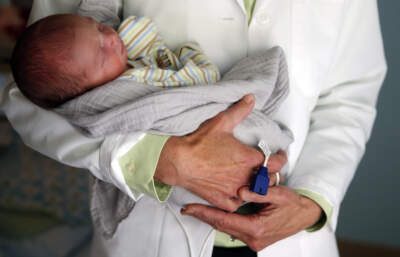
Rachel Perry Welty’s son was born three months prematurely, and spent the first eight weeks of his life in the Neonatal Intensive Care Unit at Children’s Hospital Boston. (This, after Welty spent the last 144 days of her pregnancy in bed, per doctors orders.)

Out of this anxiety-inducing maternal nightmare emerged two related pieces of art, one a literal transcription of her son’s 645 page medical chart, and the other, a color-coded rendition of his medical bill. Both works by Welty, a Gloucester-based conceptual artist, speak to the emotional extremes of the medical emergency: the deadening institutional jargon of the hospital barely concealing the sheer terror of a sick, painfully fragile baby facing an uncertain future. “It’s like dealing with a life that is out of control and trying to make it in control, however futile that may be,” Welty says.

In Transcription/Medical Record #32-52-52-001 (645 Pages) Welty hand copied every word of her son’s ICU medical chart on to twenty-three sheets of 24×18 inch graph paper. (She had to buy the records from Children’s Hospital for a few hundred dollars.) “A lot of people have asked me if it was therapeutic to do this,” Welty said in an interview. “But rather than remembering and reliving the difficult past, it was really about forgetting. I was trying to organize the pain of an experience by focusing on the utterly mundane task of transcribing the medical record, word for word, symbol for symbol.”

Transcription/Medical Record #32-52-52-001 (645 pages) (detail), 2001-2002 ink on vellum, 25 x 144 x 1 inches (23 sheets, each sheet 24 x 18 inches) Courtesy of the Artist, Barbara Krakow Gallery (Boston), Gallery Joe (Philadelphia), and Yancey Richardson Gallery (New York)

She says the year-long, daily effort of copying each character mimicked, in some ways, her experience at the hospital: putting one foot in front of the other and dealing with each new bit of information as it hit her. “You go day by day, report by report, bilirubin count to bilirubin count,” she said. Over the course of creating the piece, Welty found inconsistencies in the record, errors and facts that the doctors hadn’t disclosed. She describes the painstaking effort of creating the piece as “monk-like” or, alternatively, an expression of “maternal devotion.”

Welty started transcribing from Page 1 of the medical records — the moment her son was born, and diagnosed with “diseases of prematurity” — and copied ever single progress note and clinical detail on to translucent vellum paper (20,000 characters per page). “The entire process had me thinking about language,” she said. “To get by as the parent of a sick child, you have to learn a new language — my son was sick with acronyms.”

In the companion piece, Altered Receipt; Children’s Hospital Bill For Inpatient Services Welty created a color-code as a way of altering her son’s 37-page hospital bill receipt, which covered all of his costs in the ICU. “It’s a simple substitution cipher, like children use in play, a=green, b=yellow,” she said. “I created this code of color with Skittles-candy-colored dots that cover who knows what horrible-ness underneath.”

At the time, Welty said, her husband’s insurance covered 100% of the medical costs.

Now, at 20, her son is a healthy, 6’2″ college student. His neonatologist came to Welty’s opening at the deCordova Sculpture Park and Museum, where her first museum solo exhibition is on display until April 24. “They shook hands and reconnected,” Welty said. “The last time she saw him, he was a two-pounder.”