Some View ‘Gruesome And Sad’ Case As Victory For Women In Childbirth

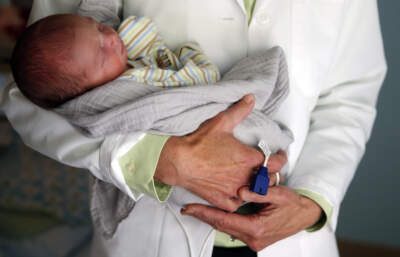
(cassy1723/flickr)

Allissa Pugh, of Milford, is an unlikely poster child for the rights of pregnant and laboring women.

But in a ruling last week, the state’s Supreme Judicial Court effectively said that the actions of women who refuse medical treatment during childbirth shouldn’t be criminalized. And that unanimous decision, some say, put Pugh at the center of a battle over whether mothers should be allowed to make their own decisions about how to progress through pregnancy and give birth.

Here’s Pugh’s story:

In the fall of 2006, Pugh was 28 and working at an animal hospital when she discovered she was pregnant, according to court records. She told no one. In January, after feeling abdominal pain, she left work, went home and sat on the toilet, thinking she might be having a miscarriage. When her water broke, Pugh realized she was in labor, the court records say. At that point, she reached inside herself, felt a foot, pushed approximately 10 times and then “pulled on the baby’s feet, legs, and body to hasten the delivery.”

Things got worse from there, the records show:

After approximately five minutes of this combined effort, the baby fully emerged from the defendant’s body.
The baby was blue. The defendant stated that she tried scooping out the baby’s mouth and made repeated attempts at rescue breaths, but the baby’s color never changed and the baby never appeared to cry or move. Despite her efforts, the defendant could not resuscitate the baby. She disposed of the baby’s body in the trash. During the delivery and immediately thereafter, she did not call for help or seek emergency medical assistance. On discovery of the mangled body several days later, a police investigation led officers to the defendant.

In 2009, a Superior Court judge found Pugh guilty of involuntary manslaughter for “inflicting fatal injuries on a viable and near full term fetus during the birthing process” in violation of her “legal duty … to refrain from wanton or reckless acts committed against her own viable fetus,” according to court records:

Specifically, the judge concluded that the defendant committed [these acts] by using “a significant amount of force” to bring about the delivery, and by failing to summon medical help on realizing she was giving birth in the “breech” position…thereby disregarding a substantial likelihood of harm…

Pugh appealed. On Friday, the SJC threw out her involuntary manslaughter conviction, reversing the lower court’s decision.

The SJC ruling, written by Justice Barbara Lenk, was, in some ways, fairly narrow: it said prosecutors failed to prove the baby was born alive or that Pugh’s failure to summon medical assistance was the cause of his death. Lenk also noted that Pugh’s was not a case of “intentional homicide.”

But the ruling also highlighted the case’s broader significance: That a woman does not have a duty to seek medical intervention when she gives birth:

…because the matter is of significant public importance…we consider the question of duty and decline to recognize a duty of a woman, in these circumstances, to summon medical assistance, breach of which may give rise to criminal liability for involuntary manslaughter..existing criminal laws proscribing murder, most late-term abortions, and the neglect and abuse of children appropriately protect the State’s interests in safeguarding viable fetuses and living children without the need to subject all women undergoing unassisted childbirth to possible criminal liability.

Imposing a broad and ill-defined duty on all women to summon medical intervention during childbirth would trench on their “protected liberty interest in refusing unwanted medical treatment….Moreover, such a duty is inchoate and would be highly susceptible to selective enforcement.

But what about the baby, wondered Worcester District Attorney Joseph Early Jr. who was quoted in The Globe rehashing the grisly details of the case: “The baby’s abdominal cavity was filled with blood. She then threw the baby’s body in a trash can, and it was only discovered when it was crushed in a trash truck. I am proud to have stood up for this child, when no one else cared what happened to him. I will continue to fight for victims…”

Pugh’s case attracted attention from a range of interest groups, including the ACLU, the Massachusetts Association of Criminal Defense Lawyers, the Women’s Bar Association of Massachusetts and others. You can read their amicus briefs here.

Andrea Kramer, an attorney at Hirsch Roberts Weinstein in Boston, wrote the brief for the women’s bar association. She said the ruling was not only a victory for women’s reproductive freedom in general, but also for women who choose unassisted births (sometimes called freebirths) and midwife-assisted home-births, the vast majority of which are thoughtfully and rationally planned.

In her brief, Kramer (who planned to birth her own children at home, but ultimately delivered in a hospital) characterized the facts of Pugh’s case as “gruesome and sad.” But those distressing facts, she wrote, shouldn’t “encroach on other areas of pregnant women’s autonomy and decision-making activity, such as where to give birth, who attends the birth, whether to obtain prenatal care, whether to follow medical advice and whether to engage in legal activities during pregnancy that might adversely affect the fetus.”

In an interview, Kramer pointed out that over many years, doctors have instituted practices and techniques that don’t always improve pregnancy outcomes or serve women well, such as having them give birth flat on their backs, shaving their pubic area or using forceps for delivery. She said, “the point is that women — not their doctors, not the legislature or prosecutors — should make the decision regarding what is best for themselves and their fetuses.” Implicit in the SJC decision, she said, is that “if you have to defer to someone, you defer to the woman because she is in the best position to make the decision and also has both hers and her fetus’s interests in mind.”

Others, who agreed with the SJC ruling, said that the Pugh case differed so dramatically from typical home-births, it should be viewed in an altogether unique context.

Eugene Declercq, a professor at Boston University School of Public Health who conducts research on childbirth trends, said via email:

I would distinguish this case from what we usually consider planned (either assisted or unassisted) home births. This seems closer to the cases of babies abandoned to shelters or emergency rooms by distraught mothers.

There has been some attention given to unassisted home births (or freebirthing as some term it) and there have been YouTube postings by some of those mothers involved, which is about as far away as one can get from the tragic case of Ms. Pugh who was trying to hide her pregnancy.

I haven’t seen any evidence that freebirthing is anything other than a very, very rare phenomenon, though there’s no hard data to prove that. The closest we can get to it with the data we have is to look at 2009 (most recent year available) U.S. data. There were a reported 9,522 home births (1/5th of 1%) attended by “other” (as opposed to doctors or midwives who are typically listed as the birth attendant) which is how an unassisted home birth would presumably be recorded. However, most of these “other attendant” births probably involve midwives…who are not licensed to do home births in a given state or accidental home births (i.e. precipitous labors).

In Massachusetts, the numbers are even more minute. In 2009, there were only 323 home births in the state and of these 20 were attended by “other.” That’s 1/30th of 1% of Massachusetts births. Given the uncertain status of Certified Professional Midwives in Massachusetts, many of the 20 actually have been midwife-attended births. Hence freebirthing, while attention-getting, doesn’t really account for many births here in Massachusetts or in the US.

Declercq added: “As a public health advocate, I’d like to see systems in place that help women like Ms. Pugh avoid such a terrible outcome.”

(For more of a visual grasp of “freebirthing,” watch this fairly graphic video with the understanding that you’ve been warned.)

  • Mina

    For a person who spent quite some years in managing and assisting women through labor and delivery, this tragic story speaks to me in different ways. As much as I absolutely advocate women’s reproductive rights, and had been advocating for a long time, I am afraid celebrating this ruling and this case is not advocating any freedom. Why reproductive freedom should be represented against children’s rights? and why people are mixing up “home delivery” with endangering behavior? An expecting mother should take responsibility for her child’s safety, no matter where she wants to deliver the baby. We certainly can give the option to mother for medical staff involvement in labor and delivery when we think there can be such an option! Labor is a natural phenomenon in most cases but can be very complicated in others. the course of labor also can change from normal to complicated rapidly. I hope all the women who opt to perform delivery on their own are aware of these facts. That is true that medicine is constantly revising, and improving some practices but those revised interventions have improved maternal and child health indexes. I feel deeply sad for this woman who had to go through/ or commit such a horrible situation but I definitely am  sadder for the newborn baby. Regardless of mother’s social-economic… status this newborn deserved a descent delivery-home or hospital- and a decent resuscitation.  It is really hard to define this woman’s motivations but for sure, even in her best interest, this case involves a great deal of intentional negligence. Informed decision making is the key elements for proper practice of any rights. I completely agree with professor Declercq in” having a proper system to help women like Ms. Pugh to avoid such a tragic outcome. “

    • Andrea Kramer

       Mina, the Court and I agree that no one should mix up home delivery and endangering behavior.  As someone who chose home births, I totally agree.  The problem is that some people, including some people in power, believe that rationally choosing a home birth with proper care endangers babies no matter what.  Criminal prosecutions and laws in other states show this to be true.  This decision – which is different from “the case” – ensures that those people cannot use what could have been law from this case to punish people who choose home births.  No one believes what this woman did was “right” – and the WBA does not applaud “the case” – but given that precedent in one case can be misapplied in another, this was a good decision on the law.

      • Inspiredbymidwifery

        Doesn’t it seem like they generally penalize home births even though most have good outcomes yet let this woman walk free when she obviously neglected her child, one way or another? I said it before, this whole thing would be so different if the body didn’t end up in the trash. 

  • JGray1

    likely the same people who refuse to vaccinate their children, thereby putting all other children at risk for horrendous fatal diseases advocate giving birth without medical “intervention”.
    these throwbacks to the days before we made incredible strides forward in eliminating birth defects and mortality are the hallmark of a very backward third world society, where people still drink out of water streams filled with sewage.
    these women would feel at home there. please go.

    • Jamie

      As a home birth mother, I must say that your comment was full of inaccuracies and very bias. I gave birth at home with a professional midwife and was 3min away from my back up hospital. My labor and birth went without a hitch producing a healthy baby girl. Oh, and by the way…she’s fully vaccinated. Try researching because in the end you’re only making yourself out to be a fool.

  • Jtapc90

    I agree with Doberwoman. It is okay to want no medical attention during childbirth but it is not okay to throw a baby, dead or alive, in the trash. I personally think she should have called someone for the simple purpose of reporting it in order to save her butt…at least legally. Free birth or unassisted birth doesn’t fit any where into this story. That is not what this was. People who birth unassisted have educated themselves to some extent. This woman was trying to hide her pregnancy. She didn’t call for help, not because she didn’t want medical attention, but because she didn’t want anyone to discover the pregnancy or the baby. SHE THREW THE BABY IN THE TRASH. No, it shouldn’t be mandatory for women to get medical attention during childbirth but there should be a boundary. The same way there is a boundary between 1st, 2nd, and 3rd degree murder, attempted murder, etc..What kind of woman or mother throws her child in the trash?

    • Andrea Kramer

      Jtapc90 and Doberwoman – you are both absolutely correct that what Alissa Pugh did in terms of not calling for help after she suddenly discovered she was in labor is not a home birth.  As someone who planned two home births (but unfortunately wound up having to go to the hospital), I appreciate your making the distinction.
      In response to your other concerns, the first thing to understand is that the prosecutor did NOT criminally charge Ms. Pugh for disposing of the baby’s body, however repugnant we think that behavior was.  She was charged with criminal negligence (3rd degree murder) for (1) failing to summon emergency medical assistance at least upon feeling the baby’s foot, (2) pulling the baby without first requesting emergency medical assistance, and (3) not reasonably caring for the baby after delivery.  The last part was not at issue in the SJC appeal – because there was no evidence that the baby was born alive.  The first two issues obviously address Ms. Pugh’s failure to call for medical help during labor.  To put it more bluntly: given how she was charged, Ms. Pugh could be found guilty ONLY if the Court recognized that she had a duty to summon medical assistance.
      While the situation at issue in the case did not involve a home birth, the Court’s concern – and the concern of the WBA and other amici – was that a decision that recognized a duty of a woman to summon (and, by extension, accept) medical care could backhandedly lead to criminal prosecutions of women who are – intelligently and logically – choosing home birth when there is a tragic outcome.
      As for boundaries, as the Court pointed out in its decision, there definitely are some.  For example, women CANNOT intentionally kill their viable fetuses (so the decision is not condoning late term abortion).  Nor can parents negligently fail to obtain medical attention for their children post-partem.  Overall, I believe the decision addresses your concerns and does so while protecting women’s autonomy and ability to make informed decisions about their pregnancy and labor.
      Lastly, in this case, Ms. Pugh’s conviction was overturned NOT because of the lack of a duty to summon medical assistance but because the SJC found that the prosecutor failed to show that what Ms. Pugh did or didn’t do led to the baby’s death or that the baby was born alive.
      - Andrea Kramer, author of amicus brief on behalf of the Women’s Bar Association of Massachusetts.

      • justamom

         In other words, if the prosecutor wanted to truly charge this woman AND see a “good” outcome, Ms. Pugh should have been charged with failure to notify authorities of the death of the fetus/of her spontaneous miscarriage.  She might still have been charged, but then cleared (for the same reasons stated above) with the death of the child, but she would have been found guilty of inappropriately disposing of the body.  To have been distressed and then attempt to remove the baby, then to fail to be able to revive the infant would have been traumatic.  That is not, in and of itself, a crime.  Nor is accidental delivery with a bad outcome a crime.  However, I, personally, find disposal of an infant in a dumpster (even one stillborn) worthy of being called criminal.

      • Jtapc90

         I do understand you points Andrea Kramer. Like I said, its not that she didn’t call for help when she discovered she was giving birth. I don’t believe any woman should be penalized for not wanting medical care whether or not it results in a bad outcome. Lets not forget, bad outcomes happen even with the best medical care. I would find this woman at no fault if the child didn’t end up in the trash. I just hope this doesn’t stir up bed news for the home birther’s and free birther’s.

  • Doberwoman

    This basically says you can perform your own late term abortion at home & throw children in garbage cans & that’s okay. Insanity. Common sense: unassisted isn’t the same thing as negligence.

    • Orangegenie1

      We don’t know if it was an abortion, per se.  The woman states she thought it was a miscarriage; many women wonder if they will miscarry if they hadn’t felt the baby move inside them. Some, especially women who’ve never had a child before, wouldn’t know what it feels like when the water breaks.  I don’t know if she had any children prior, but one wonders that if she did, wouldn’t she have recognized it coming on or about to happen? I don’t know why she didn’t just get to a phone and dial 911. Maybe it came on too fast.  I cringed in the article as she was on the toilet when this happened.  Further, a baby that’s blue is strikes me as already passed though she says she attempted resusitation. Disposing of the baby is abhorant!  She still should have called someone.  Also, a trash is like “disposing of properly” when really, burying the baby in a cemetery is the proper thing to do. Why didn’t she dial 911?  At least the baby could have been legally pronounced dead.  This woman is sick and needs mental health care.  I hope she gets her tubes tied!!

      • Jtapc90

        I agree with you on everything you said. However, my first child was blue when he was born. My midwife said its normal. I’m only saying all that because no body should ever assume anything. Babies have been brought to life by the simple embrace and caress of their mother. If she didn’t throw the child in the trash it’d be a completely different story. I’d say this woman was a victim of ignorance, possibly poverty, and fear, maybe worse for all we know. There isn’t enough proof to charge her with murder or anything but wouldn’t it be fair, for the child, to at least charge her with improper disposal of the body or some kind of neglect to call for authorities upon discovering the baby was dead?