When A Burst Appendix Doesn’t Kill You

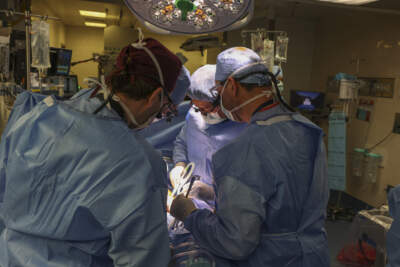
An urgent laparoscopic appendectomy performed aboard the nuclear-powered aircraft carrier USS Enterprise (U.S. Navy via Wikimedia Commons)

First, the warning label for this story: A perforated appendix can kill you. If you experience symptoms of appendicitis, particularly sharp pain in the lower right area of your abdomen, get prompt medical care.

End of warning. Now for the surprising counter-example. You’ve seen acute appendicitis on hospital shows: The patient hunched over in unbearable stomach pain, rushed to the operating room for life-saving surgery to remove the organ gone awry. That’s the popular image of appendicitis, and it does reflect reality. Appendectomies are the most common emergency operation that general surgeons perform — at a rate of more than a quarter of a million a year.

But medicine is ever-evolving, and the thinking on appendectomies has been changing in recent years. Where once acute appendicitis meant an instant trip to the operating room, that call is now becoming somewhat more nuanced, and is likely to become still more refined in coming years.

Our case in point: WBUR’s news director, Martha Little. Her appendix has burst. And she’s been working in the newsroom this week as usual, burst appendix and all. No, this is not the ultimate workaholism. She explains:

A couple of weeks ago, I thought I had food poisoning. I came in to work late that Monday, but worked long days all the rest of that week with mild shooting pains across my upper intestines. I thought I had contracted some weird virus.

Then came the weekend. My kids, my husband and I went to Fairfield, Connecticut for a family reunion. After two days of whiffle ball and frolicking in the ocean I popped open a Phil’s Blackberry Cider, ate a brownie (I know, I eat like a kid) and got in to the lukewarm hot tub. About a half an hour later, I felt myself crumpling onto the front lawn with intense abdominal pain.

I thought it was gas. My brother-in-law Remi, who just happens to be a general practitioner, was packing up his family to go home. “Remi,” I said, “I’m actually in a lot of pain.” He palpated my abdomen and thought it might not be appendicitis because the pain was all over my lower abdomen, not just on the right side, and I had no fever, no vomiting.

I hauled myself into the house and lay on the couch in agony. Remi said that if it didn’t get better in a half hour, I should go to the emergency room. But with some Advil, it did get better. And after a hot bath, I felt really better, so we drove the two and a half hours back to Boston.

WBUR news director Martha Little (pre-appendicitis)

On Tuesday — because the doctor had no time on Monday — I got a CAT scan, blood tests and an X-ray. The CAT scan showed that there was, as the doctor put it, “something cooking” around my appendix and I should “get myself to the emergency room as soon as possible.” I didn’t panic. But I did wonder if I had only minutes to live.

After going to the wrong hospital, I finally made it to the Brigham & Women’s emergency room, where I was told I would likely have the appendix taken out that night. But upon further examination, the surgeon and his resident told me that I could wait eight weeks for surgery, and meanwhile they would treat the infection with serious antibiotics.

Eight weeks!? “What,” I said, “would happen if the appendix burst?”

“It has already burst,” they said.

What? I thought people died when their appendix burst.

No, I was told. Not always.

The body, they explained, has a way of “walling off” the perforated appendix so that the infection doesn’t spread. I asked another of the four surgeons who visited me in the acute care ward: How much time does one normally have? That is, until one dies from a peritoneal infection?

After our conversation, I realized he had never answered that question. He said: You would have known it was serious when your stomach muscles contracted so much it looked like a washboard. I wisecracked, “How could I distinguish that from my normal state?” He forced a laugh.

I am now on massive doses of the antibiotics Cipro and Flagyl, and staying away from alcohol. I have also read that heating pads and hot baths are not necessarily good for you when you have appendicitis. But I wonder if the water of the bath I took helped take the pressure off and slowed the infection. Who knows? All I know is that these days, if the burst appendix doesn’t kill you, they wait until the infection goes away and then take the thing out laparoscopically, in a same-day turnaround operation.

Wow, I said to Martha. Some people get “walking pneumonia.” You have “walking appendicitis.”

But I was gently corrected by Dr. Douglas S. Smink, program director of the general surgery residency program at Brigham & Women’s Hospital. While “walking pneumonia,” which is not a medical term, tends to be a milder form of the illness, there’s nothing mild about appendicitis that has already reached the point that it has perforated the appendix. In fact, he said, it’s more severe. In the United States, perhaps 80 percent of appendicitis cases get to surgery before the organ ruptures.

The appendix marked in red (Olek Remesz, Wikimedia)

(A brief tangent: I suddenly realized that I could not picture a “perforated appendix.” Was it like a water balloon exploding? A cardboard box torn along its perforations? Dr. Smink explained: The appendix, which is about the size and shape of a pinky finger, gets very inflamed until, in one area, its muscular wall gets so thin that it breaks open, releasing the bacteria-laden fluid inside. But the fluid doesn’t explode out like a splatting water balloon; it seeps and oozes out as if the balloon had sprung a leak.)

Here’s the good news for patients like Martha: The appendix is surrounded by other structures, mostly the intestine, and so, as she was told, the seepage can get “walled off.” One theory, Dr. Smink said, is that a somewhat mobile layer of visceral fat called the omentum — nicknamed “the policeman of the abdomen” — could be drawn toward areas of inflammation to contain infection. So a patient can end up with a pus-filled abscess outside the appendix, covered partially by the omentum.

Still, why not just operate and get rid of the problem? It’s not so simple. An area rife with inflammation is hard for surgeons to work with, Dr. Smink said, and an appendectomy could end up turning into removal of part of the intestine and colon as well.

So the idea is to give the patient antibiotics to fight the infection, wait as the inflammation subsides and then do an “interval appendectomy,” after the waiting interval. (And by the way, even emergency appendectomies are done promptly but not with quite the urgency of old; waiting several hours appears to do no harm.)

A 1940s appendicitis poster (U.S. National Archives and Records Administration via Wikimedia Commons)

Twenty years ago, Dr. Smink said, surgeons would go in and operate on virtually all cases of appendicitis, whatever the level of inflammation. But research found that for a certain group of patients, it was better to wait. Now, even the “interval appendectomy” is becoming controversial; a newer school of thought holds that some patients may do best with antibiotics alone, no operation at all.

The problem right now, he said, is that there’s some data on the antibiotics-only strategy, but not enough to make clear which patients really need an appendectomy and which can get along without one. Patients who have a stone in the appendix, called an appendicolith, definitely need the organ removed, for example, but many other cases are not so clear cut. More research is needed, he said, to explore the effects of age, severity of illness and other factors on whether antibiotics-only treatment will work for a given patient.

Meanwhile, some studies also suggest that for many patients with uncomplicated appendicitis — the appendix still intact — antibiotic treatment alone may be enough as well. (I’m imagining myself as a patient with high-deductible insurance. That might pose quite a dilemma: Try just antibiotics, or take the safe but expensive route straight to the OR?)

Why are treatments for appendicitis evolving so notably away from the operating room? The general trend in surgery is that the less invasive, the better, Dr. Smink said. That’s also why more than half of appendectomies are done laparoscopically — through a tiny incision — these days. And better research leads to a better understanding of the outcomes of treatments.

Bottom line: If Martha’s appendix had blown 20 years ago, it would have long since been removed, possibly along with other parts of her. If it blew twenty years in the future, she might not end up having any appendectomy at all. You’re part of medical history, I told her.

She didn’t look very excited.


  • j

    I might have appendiciyis should I worry or get surgery?

  • vennisa

    Is there a such thing as a double appendix rupture…. my appendix burst while I was in school…it felt like a bomb went off in my right side: 4/03 then roughly two months later after suffering weight loss 127 to 87lbs..I was at a friends house and again I felt a bomb go off in me. I proceeded to get worst 105.8 fever and climbing, throwing up and passing blood. With no insurance I prayed to make it through the night. I did..I told my friends to help me home and they did. I told them good bye because I thoughtiI was dead. My aunt took me the hospital where I sat for 4 hours till I heard someone say code blue. What did they do to me..I’ve never been the same and I continue to fall apart. no lawyer to take my case..just to find answers as to why I can’t eat why I havehard pregnancy…. anyone one that can help me get.mymedical records. I don’t know what they did…my doctors don’t know what they did.

  • Art Gillman

    My wife is in the hospital with a ruptured appendix. She is being treated with antibiotics because of the delay in diagnosis. THAT is the real problem, unless the pain is in the right spot it is diagnosed incorrectly. The only thing that found her burst appendix was CT Scan. X-ray doesn’t spot it and neither did multiple blood tests. You think going to an emergency room will do it? Think again! Most ER’s do not do a CT Scan. That is why my wife went 7 days before correct diagnosis. The antibiotics take time and the pain is severe.Pain management is not perfected by any means.

  • John

    I came here because I was looking up something that happened to me 2007-2008. It was Xmas week of 2007 and I came down with what most people think when their appendix is about to burst….food poisoning. I had a strange gassy pain that started in the middle of my chest then slowly moved to the lower right side. Soon it felt like a dagger was poking me. I was throwing up and could not eat/drink anything.

    For 2 days I lived off of Nyquil and Gatorade. Gatorade is probably the sole thing that saved my life and I give credit to it to this day. The Nyquil made me sleep through the unbearable pain I was in. Why didnt I go to the Hospital? I dont know…you know when you have a headache and the medicine is in the other room so you just dont move? I dont know…

    On the 3rd day as i was walking back from the rest room I felt a pop in my lower right abdomen. Think of inserting a sword into your right shoulder from the top. It slowly slides down into your chest, then lower abdomen where it stops. Then it starts to spin. Thats the pain I felt that day. Thats the only way I know how to describe it. I crawled into bed put a warm heating pad on my side, drank the Nyquil and out I went.

    By the 6th day I was feeling…better. Surprisingly. Still had not eaten, but my Father was getting worried and He drove 3 hours to get me and bring me home for X-mas(I was in college at the time). On the way back I ate half a subway and did not throw it up! It had been 7 days since I had last eaten. The taste of orange gatorade was finally gone.

    I went to the doctor January 3rd. Appendix ruptured December 23. I feel fine at this point. Do the blood/urine tests, and the results come back saying my “liver numbers” are high. At this point I’m pretty negative about things. The word LIVE is in LIVER. Meaning you fucking need it to live! So we go get more blood/urine tests and they come back fine. Phew…

    The MRI never came because everyone thought I was better, including myself. The problem as mentioned below is that when your appendix bursts and doesnt immediately kill you, the stuff that comes out of it will sooner or later cause you to go into septic shock. A pain returned in my lower abdomen. It felt like someone would come up stab me with a dagger, and then as quick as it came, it went away. It was a strange pain. A pulse that struck my core and vibrated through my body. At first it was bearable. Over 2 weeks time it grew worse and I began to feel generally sick and weak. The first time in my life I knew something was very…very wrong. Not like when my appendix burst. Even when that happened I some how knew I was not going to die, but now I didnt seem so sure. So my Doctor scheduled an MRI and in the mean time gave me pain medication.

    The pain meds stopped the pain. January 20th The MRI date came. Now a month since my appendix ruptured and a month that the bile that leaked out had been rotting inside my body. I remember asking the MRI tech how long the test results would take. It was Sunday, he said the results would not be back until Tuesday. So we do the damn thing.

    As my grandmother and I are walking down the long narrow hallway the lab tech comes racing through the doors with a BOOM, and screams my name while sprinting towards me like he was racing the 100m.

    “See that…gma….im dead…,” Were the words I uttered right before he got to me. “ARE YOU IN PAIN!?”

    “No…thats what i got these babies for…” I hold up the bottle of pain meds.

    “Do you have antibiotics as well!?”

    “No….is that a problem?” The whole time the guy is staring at me with this puzzled look on his face. Then he would look at the MRI papers, then back at me.

    I asked him if i was going to die and he replied that his job doesnt pay him enough to tell me that, and ran away down the hall after telling me to expect an immediate call from my doctor.

    “Want to have Mexican for lunch?” asked my grandma. Why the hell not….

    I get home and the doctor phones me. The conversation went like this:

    “Hello Mr. xxxx, are you walking!?”

    “Yes…”

    “So you can move!?”

    “Yea….should I not be moving?”

    “So your totally fine? You can walk? Run? Have you been eating!?”

    “yes, yes, and yes…”

    At this point Im getting upset. Wtf do I have?! Polio!? He then tells me my appendix had ruptured but my body walled up and fixed my appendix. However the excess bile that leaked out was now killing me. He estimated at the point I was at I had roughly a week to live unless I had immediate antibiotic interference. I remember I was very yellow with jaundice…like really yellow. I have a picture that my friend took of me In the middle of it. The yellowish tint of my skin and huge dark circles under my eyes made me look almost zombie-ish.

    But yea I lived, and I still have my appendix inside me.

  • Theresa

    OK went to the hospital Monday in alot of pain they said its acute appendicitis,they just gave me meds sent me home,went back to doc and he says no its just an infection, but i still can’t eat vomiting,fever, nausea,stabbing pain on my right side and lower,so i guess i just better sit around and wait for something more to happen?

  • Atlsexyness

    I just went to the hospital exactly one week ago with a very bad stomach ache. When they gave me the sheet to write down what was wrong with me I put “The worst stomach ache Ever!” I waited hunched over in the waiting room for about 4 hours before being seen by the Doc. He pressed on my stomach a few times and it hurt to the middle right of my navel. Told me after drawing blood my white blood cell count was high then sent me to get a CT scan. 45 min later they told me I had Appendicitis. he said I had the second set of symptoms that people get such as upset stomach, irregular bowel movement, lots of gas (but I couldn’t pass mine) and feeling ill. Usually people get a loss of appetite, nausea/vomiting,fever, and pain in the lower belly on the right. Btw, I noticed my symptoms abt 4 hours after eating pizza and I blamed it on food poisoning too. If anyone has these symptoms, go to the emergency room quick! Luckily mine did not burst, but it surely felt terrible!

  • jmihalchik

    My appendix burst when I was 12 years old ……52 years ago. The doctor said I was fortunate to have what he referred to as an apron of fat below the appendix which allowed the poison to be released very slowly. I think it was about 3 months later that they opened me up to clean me out. I thought I remembered him saying that not everyone has an apron such as I did, but after all these years I could be wrong on that. My aunt who I never knew died of appendicits in the 30′s or 40′s. I was told that it was considered a major operation back then.

  • chrys

    My daughter went to Er on a thursday nite for severe stomache pain they sent her home and said it was a cyst on her ovary with (pain pills) up all nite with her next day i called the doctors got her in and they said go back to the ER she needs surgrey now she had a burst appendix this was in May where she spent 14 dayas in hospital needles in her back where they had to pull out the pockets between other organs Ivys around the clock and not only once but 3 times they had to do the needles in her back area drain tubes in her stomache with so much fluid in there 10qts and now she has had nothin but problems with her ovaries and has had 3 surgerys since May 2012 now shes always bloated for some reason but noone seems to know why this is

  • hjc24

    This happened to me in 2005. I woke up on a Sunday morning with a terrible stomachache that didn’t get better. I threw up after eating a snack on Sunday evening and went to the doctor the next day. I was given a CT scan that indicated that my appendix had ruptured but sealed itself. I spent three nights in the hospital on heavy-duty IV antibiotics and morphine (initially) for the pain, followed by a 10-day course of oral antibiotics upon discharge, that basically killed everything in my system – I told the doctor I felt like they were killing me and he said, “if you stayed on them long enough, they would!” Returned 6 weeks later for laparascopic removal of the appendix.

    The only possible complication of surgery I, among others, have experienced, is an onset of IBS after appendectomy, perhaps related to scarring of the large intestine.

  • http://profile.yahoo.com/JSRBR4IPFI4HLSAB7GIZ4PKUTI Sean

    My appendix burst while I was hiking to Machu Picchu in 2003. After writhing in pain all night long in a tent, and not being aware of what happened, I actually hiked out of there. Like Martha Little, I thought it was something else like travel sickness.  Except for the occasional fevers and uncomfortable feeling, I had no idea that it was appendicitis. I also considered constipation a possibility. But when I came home to NYC, the pain came back and I was in the hospital for over a month due to complications. I was also a minor celebrity amongst the staff for “surviving”

  • Jeannegall

    As I became aware when my son recently had a perforated appendix removed, the common misperception is that a burst appendix means instant death. It’s a medical emergency, but it is treatable. I wish people would stop telling him he’s lucky to be alive, or recounting in horror a situation in which their own appendix “almost burst!” When I asked the surgeon about these reactions, I was told that only a person lost in the wilderness would likely die of a burst appendix in this day and age. (Of course, you do need to go to the ER in a timely fashion to have your life saved, but the situation is a lot different than implied in the “Not always” in this article.) The medical community needs to do a better job of explaining the facts. I wish we had been better prepared to hear the current protocol that was explained to us in the ER,  that if it hadn’t burst they would operate the next morning but that if it had, it would be medically safer for him to put in a drain and send him back to school for 8 weeks and then operate. (They guessed that because he’d only had severe symptoms for one day that it hadn’t perforated, but found during surgery that it had been perforated for a significant period of time. Great, just when they’d convinced us you shouldn’t operate on a perforated appendix.) People need to be aware that this was not incompetence. This is not an easy condition to diagnose, and can feel like bad constipation or appear to be the flu. (The first time he went to the doctor, she said it was the flu; that night, a different doctor said to get evaluated at the ER.) So, if it doesn’t get better, go back to the ER, don’t assume as Stephen Reed did that the first diagnosis is always the correct diagnosis. It may take several days for the pain to localize in the lower right abdomen. I guess this article has moved readers a bit further toward understanding current medical practice, but the misleading headline and that “Not always” shows that the author or editor is still in thrall of out-of-date myths.

  • Giota

    I liked this article. In fact, the same exact thing happened to my dad. His appendix had burst and it “walled off” like in Mrs Little’s case. He was treated with antibiotics for several days and then after the inflammation went away he had surgery- laparoscopically. He was also treated in the Brigham & Women’s Hospital. All the staff was very nice and his surgeon! They explained everything very clearly and everything made sense. Thanks to all :)

  • jelly bellybutton

    My medical history of a burst appendix which “healed over” left me with abdominal mucus and eventually cancerous nodules in my abdomen. Beware of Pseudomyxoma Peritonei (also known as PMP), mucinous adenocarcinoma, appendix
    cancer and other associated cancers.
    These conditions are treatable but not curable. I advise seeking knowlegable medical experts in dealing with the appendix.

  • Sumo

    The article jests that antibiotics might be a cheaper treatment over surgery, but if Flagyl is the standard antibiotic regimen, that alone will set you back $1300+.  It’s not cheap stuff.

    • JEM

      Thank the collusion between your insurance company, your pharmacy and the manufacturer if that’s the price you’ve been charged:  metronidazole = Flagyl is actually dirt cheap.  How do I know?  I’m a veterinarian who purchases and prescribes this for my patients all the time.  There’s no way I could justify charging $1300/month ($43/day) for the human dose.  Astounding, but much of human medicine surprises me.

  • fracuss

    ” waiting several hours appears to do no harm.”
    Call me skeptical after spending 10 days in the hospital (7 of them in intensive care suffering from a massive infection, heart issues and hallucinations which left me with PTSD for months after).

  • Boston Surgeon

    As a surgeon I thought this was a misleading description of what appendicitis (and the appendix) is and how we treat it.  Also, the picture that accompanies that article is not sufficiently de-identified… a distinct tattoo is often more than enough.

  • DonJuan

    I’ve had a burst appendix. Had a mildly bad stomach ache, and then it got better (the appendix had burst, relieving pressure). Two days after feeling better, i was barfing and in utter agony, went to the hospital, and had my insides cleaned out (basically). You don’t die instantly after a burst appendix, the infection has to spread, and will eventually lead to sepsis, if your body doesn’t wall it off into a cyst (which is what occurred after the surgery because some infection had been left over- so another surgery occurred).

  • http://www.facebook.com/profile.php?id=1370665774 Pattie Covert

    Great article! My sister was in France as an exchange student when hers unknowingly burst. Several weeks of antibiotics cured the symptoms, and the ruptured organ was removed a year later during exploratory surgery. All is well, she’ll be 39 next week.

  • http://www.facebook.com/islandskeeter Stephen C Reed

    This article is absolutely and dangerously misleading. My appendix burst on a Sunday evening while speaking at a women’s event about natural and organic personal care products. I did not experience the extreme pain usually associated with acute appendicitis but felt as though I had the flu. I couldn’t keep anything down and threw up everything I ingested except water.. I went home to bed and the next day called my GP’s office, who told me my doctor was out of town and yes, there was a violent flu in the small town where I lived. I stayed home from my office, deciding each day to extend my bed rest – until suddenly the week had passed and on Friday my son found me unconscious on my living room rug. EMT’s rushed me to Swedish Hospital in Seattle, where surgeons saved my life with a twelve-hour emergency surgery, leaving me with an open wound large enough to secret two television remote controls – 9″ x 7″ x 5.5″ deep. I remained in the hospital for two weeks, at which time a surgeon discovered further damage and rushed me into another surgery, though only 8 hours then. One week later I was released to six months of open wound therapy with visiting nurses every 48 hours. My wound continued to spontaneously spring leaks throughout the six months, culminating with another CAT scan which discovered an enormous DVT (Deep Venous Thrombosis) in my left leg from my groin to my ankle and thousands of bilateral pulmonary embolisms. I was immediately hospitalized again and now, a year and a half after my acute appendicitis, I’m still on heavy dose warfarin. My doctors saved my life three times in six months and I feel everything since is just frosting on the cake – but my point is, PLEASE never assume immediate care for an acute appendicitis – a burst appendix – can be delayed, even for a single day. The writer of the above article told Martha she was part of medical history – but neglected to tell her the real truth is she could just as easily have been just plain history.

    • -

      The article states that surgeons, trained medical professionals, are sometimes making the decision to delay removal of the appendix during appendicitis.  This is not the same as delay of care: Martha Little was immediately treated with strong antibiotics upon her arrival at the hospital.  The article is merely reporting on changing methods of care for appendicitis, not suggesting that readers leave their appendicitis untreated.

      • fracuss

         You may have a point, but the article is still dangerously misleading.  We are not all trained M.D.s.

    • Shadow137

      Stephen thank God your alive! I agree with you 100%. My appendix burst this past Saturday and I am still in the hospital with no date of departure. I am being followed by an infectious disease doctor as well as my surgeon and PCP. My surgeon said if I had not come when I did I would have died within 6 hours. Appendix is absolutely nothing to fool around with!!!!!

    • Icterid

      The first sentence of the article: “First, the warning label for this story: A perforated appendix can kill you. If you experience symptoms of appendicitis, particularly sharp pain in the lower right area of your abdomen, get prompt medical care.” Hardly dangerously misleading. Your GP’s office dropped the ball.

  • Lgiffee

    This is why we need to hear this stuff, to allay fear and dismiss conventional, outdated (continually) notions. Thanx again BUR

  • 6712

    Really interesting and thorough piece.

    • fracuss

       I disagree that it was through…it was one sided.