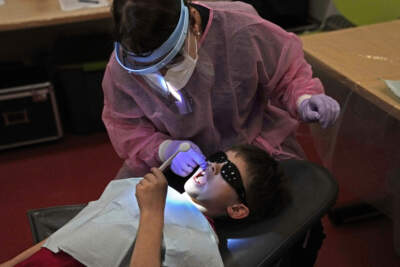
The Boston Globe’s Kay Lazar reports that insurers are profiting more off of health plans sold to Massachusetts college students, with less money actually spent on medical care. Citing an investigation by state regulators — which was initiated by student complaints — Lazar writes:
The report by the Division of Health Care Finance and Policy shows that, on average, 30 cents of every premium dollar goes toward profits and administrative costs, compared with 12 cents for plans sold to the general public. The remainder of the premiums is what’s used to pay medical bills.
Students at state schools faced the greatest disparity: 45 cents of every insurance dollar they pay goes to profit and administrative costs, according to the report.
For more than a year, students at several campuses have pushed state regulators to investigate because, they said, the lower-cost insurance products marketed to them offer limited coverage, leaving many vulnerable to enormous medical debts after accidents or serious injuries.
Eric H. Schultz, president and CEO of Fallon Community Health Plan, says Massachusetts must consider a “minimum” health insurance plan with fewer state-mandated benefits or risk an exodus of employers:
As our nation gets closer to its health care reform finish line, it’s critical to examine the potential impact on Massachusetts residents, and on our own health care reform, which we all worked hard to implement. National health care reform should allow us to preserve what’s working well, while at the same time provide opportunities for improvement.
And there is a lot that works well in Massachusetts:
– We’ve achieved nearly universal health insurance coverage.
– Residents have access to a wide variety of health plan options through the Health Connector.
– We have in place many of the health insurance consumer protections being debated nationally, such as guaranteeing access to coverage regardless of health status and ensuring that consumers can renew their coverage regardless of medical history.
– Our health plans are consistently ranked among the top in the country, in terms of clinical quality and member satisfaction.
–On average, 90 cents of every premium dollar goes directly to pay for the cost of medical care our members receive, as compared to a much lower average number for the rest of the country.
Yet this last point also alludes to what’s not working well in Massachusetts: the cost of care. We now have the highest health care costs in the country, and our medical cost trends only fortify this unenviable position.
National reform financing strategies include taxes on high-cost “Cadillac” health insurance plans, as well as other taxes on health insurance premiums. The negative impact on Massachusetts becomes clear given our health insurance premiums are higher because our health care costs are higher.
One area to consider is the Massachusetts definition of minimum creditable coverage (MCC), as compared to definitions contained within the various national reform bills. Those bills define MCC in broad terms to give each state flexibility in designing their specific benefits. Equally important, the bills set MCC actuarial requirements at a much lower level than we currently use in Massachusetts. Read more…
Marylou Buyse, M.D., a practicing primary care physician and president of the Massachusetts Association of Health Plans says the Affordable Health Plan bill, sponsored by Sen. Richard Moore and Rep. Harriett Stanley, is the only proposal out there that would provide a more affordable option to small businesses:
Keeping health care affordable is the challenge facing all of us in the health care system and we recognize that rising health care costs have fallen particularly hard on small businesses and their employees. But as the chairs of the Health Care Financing Committee asked members of the Massachusetts Medical Society and other providers that testified at Monday’s hearing of Senate Bill 2170, “If not this, then what’s your solution?” We haven’t seen any proposal from the Mass. Medical Society to help small businesses. (See the MMS post on SB 2170 here.)
Last January, the Governor and members of his Administration called on the health care industry to come together to help control health care costs. Our association answered the call, by working with Sen. Moore, Rep. Stanley, Sen. Michael Moore and small business organizations on legislation – the Affordable Health Plan – that would provide immediate relief to small businesses, reducing premiums by as much as 22 percent. No other proposal has been able to offer those types of savings.
The proposal emphasizes the goal of shared responsibility, the key tenet of Health Care Reform. The Affordable Health Plan would establish in statute a new product for businesses with 50 or fewer employees and individuals. It would establish a rate cap on providers for just this product, which would be just one of hundreds of health benefit plans available in the small group market. Read more…
Mario Motta, M.D. a Salem cardiologist and president of the Massachusetts Medical Society says a new proposal that aims to make health insurance more affordable for small businesses could bankrupt physicians and is merely a cynical attempt by insurers to avoid reigning in premiums and profits:
The latest proposal to improve our state’s health care reform effort offers no improvement at all. In fact, it’s detrimental to physicians and hospitals – and thus to patients.
This week I testified at a hastily scheduled hearing for Senate Bill 2170, filed on behalf of the Massachusetts Association of Health Plans, which would create a new kind of a health insurance plan, ostensibly to make health insurance more affordable for small business owners.
But it’s actually a cynical attempt by the health insurance industry to focus cost-cutting efforts on the state’s health care providers and away from insurance premiums. Providers who have participated willingly and enthusiastically in all of the state’s health care reform efforts to date deserve better.
Insurers now want to force physicians to participate in a health insurance product totally of their own design and whose reimbursement levels could bankrupt many physician practices.
If we don’t want to participate in these private plans but still want to serve our patients with other insurance, we should be able to do so. This bill would prohibit that. Read more…
The Los Angeles Times reports that a little-noticed measure in the health care overhaul bill would require insurers to cover Christian Science prayer sessions as a medical expense. The provision was inserted by Sen. Orrin G. Hatch (R-Utah) with the support of Democratic Sens. John F. Kerry and the late Edward M. Kennedy, both of Massachusetts, home to the headquarters of the Church of Christ, Scientist, according to the L.A. Times.
Reporters Tom Hamburger and Kim Geiger write:
The measure would put Christian Science prayer treatments — which substitute for or supplement medical treatments — on the same footing as clinical medicine. While not mentioning the church by name, it would prohibit discrimination against “religious and spiritual healthcare.”
It would have a minor effect on the overall cost of the bill — Christian Science is a small church, and the prayer treatments can cost as little as $20 a day. But it has nevertheless stirred an intense controversy over the constitutional separation of church and state, and the possibility that other churches might seek reimbursements for so-called spiritual healing.
For all the hoopla over whether or not a goverment-run public insurance option will be included in national health reform legislation, a new analysis by reporters at Kaiser Health News finds that the public option may, in fact, only play a “miniscule” role in expanding health care in the U.S. The report says:
Of the 30 million Americans likely to purchase insurance through exchanges created by the legislation, only six million — or one fifth — would enroll in a public insurance plan, according to a Congressional Budget Office analysis of the House bill. Viewing it another way, the six million using the public option would amount to only two percent of the 282 million Americans under the age of 65 who are projected to have health insurance by 2019, when the legislation is fully implemented.
And that number could shrink because states may decide to opt out of a public insurance plan, an escape clause that’s likely to be included in the Senate plan.
“The politics of this issue is totally disproportionate to its likely impact one way or another,” said Bruce Vladeck, a former administrator of the federal agency now called the Centers for Medicare and Medicaid Services.
This just in from Martha Bebinger, who is on a yearlong Nieman Fellowship at Harvard: The Nieman Foundation Guide to Covering Pandemic Flu. It’s written by and for journalists, but it’s an excellent resource for anyone interested in flu (and who isn’t these days?) It covers every possible angle, from the science and history of flu, to pandemic preparedness and crisis comunication. And there’s a great glossary.
On Thursday, The Wall Street Journal announced it would close the paper’s Boston bureau, where I worked from 2002-2008. As my colleagues, family and friends know, I certainly had my professional ups and downs during those years. After my children were born, I went part-time, and stopped caring as much about being first in the news, and more about being true, which is much harder. I wrote less about the politics of drug pricing and more about things like belly dancing in labor, or how a mom fought back when her baby received abominable medical care. But despite my changing relationship with reporting during those years, there was some amazing journalism committed in the bureau at 10 Post Office Square: Dan Golden’s education coverage, for example; James Bandler’s stories about the excesses of Jack Welch; David Armstrong’s investigative coverage of the medical industry; and Rob Tomsho’s Ahed’s, the memorable features that ran down the middle of the front page.
The great thing about the Journal — from the moment I started, in Seattle, in 1998 — was that we were given the freedom to go after a good story, and if it was really good, to follow it wherever it took us, for as long as it took. Those days seem to be gone forever.
On Thursday morning, with no warning, reporters received a memo to show up for a 10 am meeting, according to people involved. When they arrived, several executives in suits were in the room and it was impossible not to sense doom. The journalists were told they’d be paid through the end of the year, and would get two weeks severance for every year worked. Then the messengers went back to midtown Manhattan, NewsCorp. headquarters, and nine great reporters were out of work.
On Friday there was a lot of gallows humor in the newsroom, I was told, and one veteran reporter told a younger one: “You’re a smart kid. Get out of journalism while you can.”
It’s probable that neither of them — like so many of us — will ever work again as a reporter for a daily newspaper. But at least, for a while, we got to write for one of the greatest papers in the world.
–Rachel Zimmerman
Kaiser Health News reports on a new study out of Johns Hopkins Children’s Center in Baltimore that found an estimated 17,000 children may have died unecessarily due to lack of health insurance. The study, which looked at mortality over 20 years and was published in the Journal of Public Health, found that uninsured kids were 1.6 times more likely to die that children with health insurance.

Dr. Daniel E. Forman
Everyone in health care pays lip service to prevention. Wellness programs are all the rage among employers. But Dr. Daniel E. Forman, director of cardiac rehabilitation at the Brigham and Women’s Hospital, and Dr. Philip A. Ades, director of cardiac rehabilitation and prevention at the University of Vermont College of Medicine, assert that in reality, prevention efforts are undervalued, and physicians that focus on prevention are marginalized by the medical community. Among other problems, prevention and rehab programs are meagerly reimbursed. But the overarching obstacle, they say, is there remains, “a preference for hospitals and caregivers to promote expensive, high-tech procedures that garner prestige and immediate profit in a fee-for-service healthcare model.”

Dr. Philip A. Ades
This post, jointly written by Dr. Forman (who is set to launch the Brigham’s new cardiac rehab center in Foxborough later this month) and Dr. Ades, focuses on cardiac rehabilitation, where the economic divide between prevention and aggressive treatment is particularly stark. It offers an important lesson for policy makers trying to revamp a system so profoundly entrenched:
The capacity of interventional cardiologists to dramatically avert death during an acute heart attack by deploying coronary stents has led to disproportionate financial and political prioritization for what is only one aspect of therapy for coronary artery disease (CAD). In fact, the underlying atherosclerotic process, which involves the thickening and hardening of the artery walls, is a lifelong and diffuse disease, starting in one’s early life and progressively worsening over decades as cardiac risk factors and their detrimental impact accumulate. So even while urgently placed stents can save the lives of heart attack patients by restoring vital blood flow through a discrete arterial blockage around the heart, they do little to moderate the overall progression of disease. With or without stents, there remains a powerful mandate for prevention as the most fundamental aspect of CAD management, i.e., only prevention (exercise, nutrition and medications) can moderate progression of the atherosclerotic process to minimize cardiac symptoms, heart attacks and other coronary events.
Nonetheless, in contrast to the glamour and heroics associated with an acute intervention to stave off death, the lifelong self-discipline and medical detail needed for effective CAD preventive therapy rarely commands similar attention or resources among patients or even their physicians. Given today’s national discussion regarding health care costs, it seems particularly important to emphasize that CAD prevention can extend life and prevent costly cardiac procedures and hospitalizations for acute coronary events. Nonetheless, cardiac rehabilitation and other cardiovascular prevention programs are often undersized or even closed as there remains a preference for hospitals and caregivers to promote expensive, high-tech procedures that garner prestige and immediate profit in a fee-for-service healthcare model.
JM is a clinical case that exemplifies the ironic dynamics that replay themselves on a regular basis in our best cardiovascular centers. He is a 54-year-old male with several weeks of chest pain (CP) that occurs when he exerts himself. While he was not on any medication for his chest pain, he arrived at the hospital during one of his episodes, and within minutes he was referred for an emergency catheterization. The catheterization images showed diffuse coronary artery disease including a discrete 70% lesion in one vessel. A coronary stent was recommended by the cardiologist. The CP resolved. The bill was over $25,000 for this successful procedure. Read more…