<?xml version="1.0" encoding="UTF-8"?>
<rss version="2.0"
	xmlns:content="http://purl.org/rss/1.0/modules/content/"
	xmlns:wfw="http://wellformedweb.org/CommentAPI/"
	xmlns:dc="http://purl.org/dc/elements/1.1/"
	xmlns:atom="http://www.w3.org/2005/Atom"
	xmlns:sy="http://purl.org/rss/1.0/modules/syndication/"
	xmlns:slash="http://purl.org/rss/1.0/modules/slash/"
	xmlns:media="http://search.yahoo.com/mrss/"
    xmlns:dcterms="http://purl.org/dc/terms/">

<channel>
	<title>CommonHealth | Money</title>
	<atom:link href="http://commonhealth.wbur.org/category/money/feed" rel="self" type="application/rss+xml" />
	<link>http://commonhealth.wbur.org</link>
	<description>Reform And Reality</description>
	<lastBuildDate>Wed, 22 May 2013 21:45:25 +0000</lastBuildDate>
	<language>en-US</language>
	<sy:updatePeriod>hourly</sy:updatePeriod>
	<sy:updateFrequency>1</sy:updateFrequency>

		<item>
		<title>Mass. Health Cost Watchdog Says Partners Merger Raises Red Flags</title>
		<link>http://commonhealth.wbur.org/2013/05/health-policy-panel-cost-partners</link>
		<comments>http://commonhealth.wbur.org/2013/05/health-policy-panel-cost-partners#comments</comments>
		<pubDate>Wed, 22 May 2013 19:41:10 +0000</pubDate>
		<dc:creator><![CDATA[Carey Goldberg]]></dc:creator>
				<category><![CDATA[Insurance]]></category>
		<category><![CDATA[Medicine/Science]]></category>
		<category><![CDATA[Money]]></category>
		<category><![CDATA[Politics]]></category>
		<category><![CDATA[health policy commission]]></category>

		<guid isPermaLink="false">http://commonhealth.wbur.org/?p=30602</guid>
		<description><![CDATA[The new Massachusetts Health Policy Commission launches its first review to check the cost and market impact of a hospital merger.]]></description>
                <content:encoded><![CDATA[<p>Looks like the health-cost-control rubber is just beginning to hit the road. This just in from the Health Policy Commission, the independent agency created under the 2012 Massachusetts law aimed at containing health costs:</p>
<blockquote><p>HEALTH POLICY COMMISSION INITIATES FIRST COST &amp; MARKET IMPACT REVIEW</p>
<p>Partners, South Shore Hospital merger to be examined for potential effects on costs and the health care market</p>
<p>BOSTON – Wednesday, May 22, 2013 – The Health Policy Commission (HPC) today initiated its first Cost and Market Impact Review (CMIR) by notifying Partners Healthcare System and South Shore Hospital that it will examine the potential effects of their proposed merger on costs and the health care market.</p>
<p>“CMIRs are an important tool to enhance the transparency of significant changes to our health care system,” said HPC Executive Director David Seltz. “Almost every day we hear about new developments in our health care market. These reviews help us consider the impact of those developments on health care costs and market functioning. We are committed to conducting them on consumers’ behalf in a timely and thorough manner.”</p>
<p>The HPC’s preliminary review of this proposed transaction found that given Partners’ size and high costs, an expansion of that system to include South Shore Hospital, a large, high-cost community hospital, is likely to have a significant impact on the Commonwealth’s ability to meet its health care cost growth goals, and on the competitive market. To enhance public understanding of the potential costs and benefits of this transaction, the HPC is proceeding with a further examination.</p>
<p>“The HPC was set up to be a watchdog to monitor the health care market,” said HPC Chair Dr. Stuart Altman. “CMIRs are one of the ways we will fulfill that important role as we work to build a more affordable, effective, accountable, and transparent system. I look forward to discussing the merits and next steps for this specific review with the commissioners and the public at our June meeting.”</p>
<p>Seltz will report on the CMIR at the Commission’s next public meeting, Wednesday, June 19, 2013, and Commissioners will vote whether to continue with the review. The CMIR will include analyzing information from the parties and other market participants, developing a preliminary report, and issuing a final report. The proposed transaction cannot be completed until 30 days after the HPC issues its final report. The HPC may also refer its findings to the Attorney General for possible further action on behalf of health care consumers.</p></blockquote>
<p>The response from Partners spokesman Rich Copp: &#8220;The proposed affiliation between Partners, Brigham and Women’s Hospital and South Shore Hospital will offer patients in southeastern Massachusetts more coordinated, accessible and affordable health care.  We have always anticipated that the Health Policy Commission would review our proposal, and we look forward to taking this next step forward in the process.&#8221;</p>
<p>Looking for fine print? The HPC is <a href="http://www.mass.gov/anf/budget-taxes-and-procurement/oversight-agencies/health-policy-commission/">here</a> and I just signed up to follow them on Twitter at @Mass_HPC. Anybody else feeling extremely intrigued about how this review will play out, and what it will mean for the state&#8217;s efforts to contain health costs?</p>
]]></content:encoded>
                		
    <media:content url="http://commonhealth.wbur.org/files/2013/05/Screen-shot-2013-05-22-at-3.25.20-PM-620x332.jpeg" type="image/jpeg" height="332" width="620" medium="image">
            <media:thumbnail url="http://commonhealth.wbur.org/files/2013/05/Screen-shot-2013-05-22-at-3.25.20-PM-140x140.jpeg" height="140" width="140" />
            <media:description><![CDATA[The Massachusetts Health Policy Commission (Source: HPC on Twitter)]]></media:description>
    </media:content>
		<dcterms:modified>2013-05-22T17:45:25-04:00</dcterms:modified>
    	</item>
		<item>
		<title>Budget Victim: Inspections For Compounding Pharmacies. Really?</title>
		<link>http://commonhealth.wbur.org/2013/05/budget-cut-inspections-for-compounding-pharmacies</link>
		<comments>http://commonhealth.wbur.org/2013/05/budget-cut-inspections-for-compounding-pharmacies#comments</comments>
		<pubDate>Mon, 20 May 2013 21:27:29 +0000</pubDate>
		<dc:creator><![CDATA[Rachel Zimmerman]]></dc:creator>
				<category><![CDATA[Medicine/Science]]></category>
		<category><![CDATA[Money]]></category>
		<category><![CDATA[Politics]]></category>
		<category><![CDATA[budget]]></category>
		<category><![CDATA[compounding pharmacies]]></category>
		<category><![CDATA[meningitis]]></category>
		<category><![CDATA[public health]]></category>

		<guid isPermaLink="false">http://commonhealth.wbur.org/?p=30527</guid>
		<description><![CDATA[The Incidental Economist reports that new money that was supposed to be spent on inspections of compounding pharmacies is cut in the latest budget proposal.]]></description>
                <content:encoded><![CDATA[<p>Remember all that outrage last year when we learned that a Framingham compounding pharmacy, the <a href="http://commonhealth.wbur.org/2012/10/fda-mold-meningitis">New England Compounding Center</a>, was at the heart of national meningitis outbreak? And remember what followed: a flurry of new government oversight measures, tough public health safeguards, pledges of &#8220;Never again.&#8221; </p>
<p>So what happened? </p>
<p>Kevin Outterson, a professor at the Boston University School of Law and co-director of the Health Law Program,   <a href="http://theincidentaleconomist.com/wordpress/cutting-the-budget-for-inspections-of-compounding-pharmacies/">reports</a> today that additional money that was supposed to be used to inspect compounding pharmacies around the state was cut to zero. At least for now.</p>
<p>Blogging for The Incidental Economist, he reminds us why the inspections are <a href="http://www.nejm.org/doi/full/10.1056/NEJMp1212667">important</a>: &#8220;fungal meningitis from improperly compounded products killed 55 people and infected more that 600.&#8221;   But apparently, in the latest state budget proposal, money for inspections has been cut, Outterson writes: </p>
<blockquote><p>All of these products originated in Massachusetts, but all of the injuries occurred in other states. But Massachusetts felt some responsibility for the failures at NECC, as acknowledged by both Gov. Patrick and the Interim Commissioner of Public Health.  The DPH enacted emergency regulations on Nov. 1, 2012 and the Governor’s special commission delivered a comprehensive set of recommendations.  Both efforts informed the Governor’s proposed legislation in January 2013 and several bills pending in the Massachusetts House and Senate.<span id="more-30527"></span></p>
<p>In the interim, the Governor <a href="http://www.mass.gov/eohhs/gov/newsroom/press-releases/dph/update-on-unannounced-pharmacy-inspections-announced.html">boosted </a>the budget for inspections at compounding pharmacies.  In a series of surprise inspections, just 4 out of 37 compounding pharmacies passed.  The Governor proposed an additional $1 million for pharmacy inspections next year.</p>
<p>So it comes as a surprise that the Governor’s requested budget was cut to zero by the Massachusetts Senate Ways &amp; Means FY 2014 proposed budget (4510-0772).  Sen. Keenan has filed an amendment to restore about $600,000 for additional compounding pharmacy inspections (proposed amendment 513), but it is not clear whether that amendment will pass or whether that amount is sufficient. Action by the US Congress may take some time, so it is up to the states to police compounding pharmacies until we get federal legislation.
</p></blockquote>
]]></content:encoded>
                		
    <media:content url="http://commonhealth.wbur.org/files/2013/05/Screen-shot-2013-05-20-at-5.19.39-PM.png" type="image/jpeg" height="165" width="328" medium="image">
            <media:thumbnail url="http://commonhealth.wbur.org/files/2013/05/Screen-shot-2013-05-20-at-5.19.39-PM-140x140.png" height="140" width="140" />
            <media:description><![CDATA[(WBUR)]]></media:description>
    </media:content>
		<dcterms:modified>2013-05-21T10:42:24-04:00</dcterms:modified>
    	</item>
		<item>
		<title>Mapping The Ever-Shifting Mass. Hospital Landscape</title>
		<link>http://commonhealth.wbur.org/2013/05/mapping-mass-hospital-landscape</link>
		<comments>http://commonhealth.wbur.org/2013/05/mapping-mass-hospital-landscape#comments</comments>
		<pubDate>Mon, 20 May 2013 14:07:03 +0000</pubDate>
		<dc:creator><![CDATA[Rachel Zimmerman]]></dc:creator>
				<category><![CDATA[Medicine/Science]]></category>
		<category><![CDATA[Money]]></category>
		<category><![CDATA[Blue Cross Blue Shield of Massachusetts]]></category>
		<category><![CDATA[hospital systems]]></category>
		<category><![CDATA[hospitals]]></category>
		<category><![CDATA[partners healthcare]]></category>
		<category><![CDATA[steward health care system]]></category>

		<guid isPermaLink="false">http://commonhealth.wbur.org/?p=30513</guid>
		<description><![CDATA[A new interactive online map shows the state of the medical industrial marketplace in Massachusetts.]]></description>
                <content:encoded><![CDATA[<p>Thanks to health policy guru <a href="http://www.boston.com/lifestyle/health/health_stew/2013/05/how_concentrated_is_mass_healt.html">John McDonough</a> for highlighting the <a href="http://bluecrossmafoundation.org/">Blue Cross Blue Shield of Massachusetts&#8217;</a> new <a href="http://bluecrossmafoundation.org/delivery-system-map/">Health Care Delivery System Map</a> which offers a snapshot of the state&#8217;s medical industrial complex as it becomes increasingly concentrated. There&#8217;s great data here, and it&#8217;s fairly easy to sort, from hospital revenue, ownership and geography to the latest info on mergers, acquisitions and new partnerships. </p>
<p>This online, interactive site won&#8217;t tell you where to get the best colonoscopy or most specialized cancer care, for instance, but it does offer insight into the scope and breadth of the marketplace. It essentially provides a baseline view of the state-of-the-industry for all the Mass. hospitals and hospital systems, medical groups, doctor networks and community health centers. </p>
<p>As McDonough writes: </p>
<blockquote><p>For example, if you want to begin to understand why Partners Healthcare is so dominant in the state&#8217;s healthcare market, don&#8217;t go to this page, <a href="http://bluecrossmafoundation.org/delivery-system-map/delivery-system-map/story/hospital_systems/">Hospital Systems by Size</a>, on which Partners is #2 after Steward Health Care System.  Go this this page: <a href="http://bluecrossmafoundation.org/delivery-system-map/delivery-system-map/story/physician_networks/">Physician Networks and Major Medical Groups</a>, where the size of Partners&#8217; physician network (called Partners Community Healthcare Inc., PCHI, or &#8220;peachy&#8221;) is larger than #2 (Steward) or #3 (Atrius), combined.  </p>
<p>Or look at hospitals by <a href="http://bluecrossmafoundation.org/delivery-system-map/delivery-system-map/story/hospital_systems/">Net Patient Service Revenue</a>, and see that Partners total NPSR in 2010 ($4.2 billion) was the same as #s 2 (UMass Memorial), 3 (Steward), and 4 (Beth Israel Deaconess) combined.</p>
<p>Don&#8217;t forget this helpful page of <a href="http://bluecrossmafoundation.org/delivery-system-map/delivery-system-map/story/recently_changed/">Recent Changes</a> in the Massachusetts health care market. </p></blockquote>
<p>Readers, please roam around the site and let us know what&#8217;s interesting or useful to you.</p>
]]></content:encoded>
                		
    <media:content url="http://commonhealth.wbur.org/files/2012/08/masswelcomes-you-620x465.jpg" type="image/jpeg" height="465" width="620" medium="image">
            <media:thumbnail url="http://commonhealth.wbur.org/files/2012/08/masswelcomes-you-140x140.jpg" height="140" width="140" />
            <media:description><![CDATA[(jimmywayne/flickr)]]></media:description>
    </media:content>
		<dcterms:modified>2013-05-20T10:10:27-04:00</dcterms:modified>
    	</item>
		<item>
		<title>Silence As Kids&#8217; Psych Beds Cut; What If Cancer Or Burn Beds?</title>
		<link>http://commonhealth.wbur.org/2013/05/kids-psych-beds-cambridge</link>
		<comments>http://commonhealth.wbur.org/2013/05/kids-psych-beds-cambridge#comments</comments>
		<pubDate>Thu, 16 May 2013 17:30:52 +0000</pubDate>
		<dc:creator><![CDATA[Lisa Lambert]]></dc:creator>
				<category><![CDATA[Medicine/Science]]></category>
		<category><![CDATA[Money]]></category>
		<category><![CDATA[Personal Health]]></category>
		<category><![CDATA[Cambridge Health Alliance]]></category>
		<category><![CDATA[cambridge hospital]]></category>
		<category><![CDATA[pediatrics]]></category>
		<category><![CDATA[psychiatry]]></category>

		<guid isPermaLink="false">http://commonhealth.wbur.org/?p=30305</guid>
		<description><![CDATA[An advocate for families with mentally ill children decries the loss of much-valued psychiatric beds at Cambridge Hospital.]]></description>
                <content:encoded><![CDATA[<p><em>The CDC has just released <a href="http://www.cdc.gov/mmwr/preview/ind2013_su.html">a report</a> on the prevalence of mental illness among American children. It notes: &#8220;A total of 13%–20% of children living in the United States experience a mental disorder in a given year, and surveillance during 1994–2011 has shown the prevalence of these conditions to be increasing.&#8221;</em></p>
<p><em>Yet as that prevalence increases, treatment options are decreasing, writes Lisa Lambert, executive director of the Parent/Professional Advocacy League, which advocates for Massachusetts families with mentally ill children. Below, she discusses one particular pending loss, of Cambridge Hospital children&#8217;s psychiatric beds long especially valued by families. The hospital announced last month that it would consolidate two units with 27 beds into just one with 16 beds. It cited tight budgets, declining utilization and cyclical demand. The details are still in play.<br />
</em><br />
<strong>By Lisa Lambert<br />
Guest contributor<br />
</strong></p>
<p>When Aiden was seven, it seemed like he would never be safe.</p>
<p>At home and in his second-grade classroom, he repeatedly talked about killing himself. He barely slept, raced from one spot to another and threatened to harm his younger sister. His parents stayed glued to his side, barely taking time to eat, shower or sleep.</p>
<p>One day, his mother caught him lighting a fire in his bedroom. Aiden ended up in the emergency room, and later in a bed in Cambridge Hospital. The staff had seen young patients like him before and they knew what treatment would work and what kind of follow-up care a seven-year-old needs. Without that hospital stay, his mother says, ”We don’t know where our family would be.”</p>
<p>No one likes the idea of admitting a young child to an inpatient psychiatric program. It is a last resort, something to be avoided at all costs. Parents will tell you, however, that when they’ve exhausted all the options, Cambridge Hospital has provided the best possible care. Now, it seems that a major piece of that care is coming to a close, unless a miracle happens.</p>
<p>Last week, the Department of Public Health held a hearing to receive comments about closing the Cambridge Hospital child psychiatric unit and eliminating beds. Nurses stood shoulder to shoulder to tell stories of families they’ve helped and of their pride in the wonderful care they’ve given. Parents came to say that this place was a lifesaver and without it, their children would never have improved.</p>
<p>The Child Assessment Unit is one of a kind, they all said, where parents can visit anytime and even stay overnight. Since PPAL is a grassroots organization, we surveyed families about this and want their voices to be part of the public conversation.<span id="more-30305"></span></p>
<p>Three years ago, there were 310 inpatient beds for children and teens in Massachusetts. Today there are 252. If those 11 beds at Cambridge Hospital close, that number will be even smaller.</p>
<p>Each spring there is a surge in children with mental health crises and each spring there are waits of hours, even days, for the beds we do have. One mother reported that her very unsafe daughter spent “several days in a locked local emergency room” last fall and again this spring waiting for a bed to become available. Others tell stories of how their child was sent two hours away for inpatient treatment and worry this will become more common.</p>
<p>What they aren’t saying, but needs to be clearly pointed out, is that an additional burden will fall on families who are already overtaxed. Families whose children have mental health needs already have enormous responsibility for their child’s safety and care. When they cannot find a needed hospital bed, parents run a hospital-unit-for-one in their home at great cost to themselves and their other children.</p>
<p>As one parent pointed out, closing beds has a “major long-term impact on the immediate family, the community and society as a whole. We have to stop removing help while we pile responsibility and blame on the families.”</p>
<p>And then there’s the lack of parity for mental health. Besides their worries about shrinking services, nearly all parents felt this trend in closing beds was a form of discrimination. One wrote, “What would people say or do if they were closing a pediatric cancer center or burn unit? Isn’t anyone outraged that pediatric psychiatric beds are being closed?”</p>
<p>It’s well documented that medical beds for children are filled throughout the year, while psychiatric beds are in demand in the winter and spring and often empty in the summer. But inpatient care is not like a product from Apple or the Gap that doesn’t sell well. If this care becomes scarce, children with suicidal or risk-taking behavior can’t find a substitute product.</p>
<p>Everyone agrees we should find a way to provide good care to children who need inpatient care. And we all seem to agree that Cambridge Hospital has long provided that care because of their dedicated staff and wonderful, innovative practices.</p>
<p>Massachusetts is the place where the telephone, chocolate chip cookie and zipcar were all invented. It seems like we have the ingenuity and dedication to create a solution. Many parents sure hope so.</p>
<p><em>[Posted by Carey Goldberg]</em></p>
]]></content:encoded>
                		
    <media:content url="http://commonhealth.wbur.org/files/2012/12/LisaLambert.jpeg" type="image/jpeg" height="300" width="200" medium="image">
            <media:thumbnail url="http://commonhealth.wbur.org/files/2012/12/LisaLambert-140x140.jpeg" height="140" width="140" />
            <media:description><![CDATA[Lisa Lambert of PPAL (Courtesy)]]></media:description>
    </media:content>
		<dcterms:modified>2013-05-16T13:30:52-04:00</dcterms:modified>
    	</item>
		<item>
		<title>What Mass. Hospitals Charge Vs. What They Get Paid</title>
		<link>http://commonhealth.wbur.org/2013/05/medicare-data-backlash</link>
		<comments>http://commonhealth.wbur.org/2013/05/medicare-data-backlash#comments</comments>
		<pubDate>Mon, 13 May 2013 15:34:44 +0000</pubDate>
		<dc:creator><![CDATA[Carey Goldberg]]></dc:creator>
				<category><![CDATA[Insurance]]></category>
		<category><![CDATA[Money]]></category>
		<category><![CDATA[medicare]]></category>

		<guid isPermaLink="false">http://commonhealth.wbur.org/?p=30182</guid>
		<description><![CDATA[Some people play fantasy football, some knit. We here at CommonHealth sometimes like to play with health care data &#8212; most recently, a trove of Medicare numbers released last week on how much hospitals officially charge for common procedures and how much Medicare actually pays for them. WBUR&#8217;s Alex Kingsbury first took a look at &#8230;]]></description>
                <content:encoded><![CDATA[<p>Some people play fantasy football, some knit. We here at CommonHealth sometimes like to play with health care data &#8212; most recently, <a href="http://www.cms.gov/Research-Statistics-Data-and-Systems/Statistics-Trends-and-Reports/Medicare-Provider-Charge-Data/index.html">a trove of Medicare numbers</a> released last week on how much hospitals officially charge for common procedures and how much Medicare actually pays for them.</p>
<p>WBUR&#8217;s Alex Kingsbury first took a look at the wide range in Massachusetts hospitals&#8217; charges for a single category, treatment of chronic lung disease, <a href="http://commonhealth.wbur.org/2013/05/hospital-prices-vary-mass">here</a>. His map illustrated a strikingly broad range from $8,918 to $52,729. Now, in the map above, he rejiggers his Google Fusion Table to explore a broader question I put to him: How do the hospitals shake out in terms of the percentage of their official charges that they get from Medicare?</p>
<p>And here&#8217;s a fun little factoid that emerges from the map: That range goes from procedures for which the Medicare payment amounts to less than 18 percent of the charges billed to well over 100 percent of the charges billed. I&#8217;d thought this recalculation of the data might yield some interesting insights &#8212; Who most overcharges? Or who might feel most shafted by government payments? &#8212; but it runs such a crazy gamut that perhaps it serves mainly as yet another indicator of just how distorted and Byzantine and broken the American health care market is. (Didn&#8217;t need any further proof of that? Fine. Just enjoy playing with the map.)</p>
<p><span style="font-size: 14px">Last week&#8217;s release of the Medicare data brought a media splash &#8212; particularly among data-visualization fans like <a href="http://www.washingtonpost.com/blogs/wonkblog/wp/2013/05/08/one-hospital-charges-8000-another-38000/">the Washington Post</a> &#8212; but also a backlash.</span></p>
<p>Health care economist Uwe Reinhardt pointed out that the official hospital charges are famously irrelevant to the reimbursement that health insurers actually pay, to the point that he called last week&#8217;s fuss about the Medicare data laughable. He wrote <a href="http://economix.blogs.nytimes.com/2013/05/10/american-health-care-as-a-source-of-humor/?">in The New York Times</a>:</p>
<blockquote><p>Even funnier are the protestations by hospital executives that hardly anyone ever pays these fictional prices, which prompted me to offer the following technical definition: “ ‘Charges’ are the prices that a totally inebriated foreign billionaire would pay a U.S. hospital if his wife were not around to control the bloke.”</p></blockquote>
<p>Former Beth Israel Deaconess Medical Center chief Paul Levy also <a href="http://runningahospital.blogspot.com/2013/05/useless-noise-from-cms.html">blasted the Medicare data as &#8220;useless noise&#8221;</a>:<span id="more-30182"></span></p>
<blockquote><p>This is a case where the release of bad data is worse than having no data at all.</p>
<p>A hospital&#8217;s chargemaster is an archaic fiction, a way previously used to allocate the joint and common costs of the hospital to particular services. It does not serve as the basis for how much a hospital is paid by Medicare. It does not serve as the basis for how much a hospital is paid by Medicaid. It does not serve as the basis for how much a hospital is paid by private insurers.</p>
<p>Further because of federal and state prohibitions against balance billing of patients (i.e., the difference between the amount paid by an insurer and the amount of the charge), it also provides no basis to consumers that means anything at all.</p></blockquote>
<p>We might add, particularly here in Massachusetts, where almost everyone is insured and thus unlikely to pay full bills out of pocket. Ah, well &#8212; fun to see the maps, anyway, and every reminder of just how dysfunctional our market is may act as a prod toward improvement. Readers, is there anything you&#8217;d most like to see mined out of these data? Do you agree with the critics, or do you see any use in Medicare&#8217;s release?</p>
]]></content:encoded>
                		
    <media:content url="http://commonhealth.wbur.org/files/2013/05/Screen-shot-2013-05-13-at-11.30.13-AM-620x466.jpeg" type="image/jpeg" height="466" width="620" medium="image">
            <media:thumbnail url="http://commonhealth.wbur.org/files/2013/05/Screen-shot-2013-05-13-at-11.30.13-AM-140x140.jpeg" height="140" width="140" />
            <media:description><![CDATA[]]></media:description>
    </media:content>
		<dcterms:modified>2013-05-13T11:34:44-04:00</dcterms:modified>
    	</item>
		<item>
		<title>Small Biz Insurance Rates Hold Steady In Mass, For Now</title>
		<link>http://commonhealth.wbur.org/2013/05/small-biz-insurance-rates-hold-steady-in-ma-for-now</link>
		<comments>http://commonhealth.wbur.org/2013/05/small-biz-insurance-rates-hold-steady-in-ma-for-now#comments</comments>
		<pubDate>Fri, 10 May 2013 10:34:54 +0000</pubDate>
		<dc:creator><![CDATA[Martha Bebinger]]></dc:creator>
				<category><![CDATA[Insurance]]></category>
		<category><![CDATA[Money]]></category>
		<category><![CDATA[cost]]></category>
		<category><![CDATA[small business]]></category>

		<guid isPermaLink="false">http://commonhealth.wbur.org/?p=30122</guid>
		<description><![CDATA[Health insurance premiums for small firms are set to increase from a base of 2.5%, on average, in July. But these rates  may be the calm before the storm.

Health insurance premiums for small firms are set to increase from a base of 2.5%, on average, in July.]]></description>
                <content:encoded><![CDATA[<p>The latest small business health insurance rates may be the calm before the storm.</p>
<p>Premiums for small firms are set to increase from a base of 2.5%, on average, in July. That&#8217;s slightly less than the average increase of 2.7% this quarter. Employers willing to live with limits on where they and employees receive care could see premiums drop (take a look below at Neighborhood Health Plan and Celitcare). And notice that no one filed (or was approved for) rate increases above 3.6%, the current magic number for health care cost caps in Massachusetts.</p>
<p>But things may look quite different as of January 1st. Very small businesses could see modest increases or perhaps lower rates. But insurers are warning that firms with 20-50 workers could see premiums jump 30% when parts of the federal health care law kick in next year.</p>
<p>&#8220;We all thought that Mass. was going to be held harmless under the ACA, but that looks like that&#8217;s not going to be the case, at least not for small businesses,&#8221; says Jon Hurst, President of the Retailers Association of Massachusetts. &#8220;We&#8217;re going to be looking at a lot of small businesses getting extreme, double digit increases come next year.&#8221;<span id="more-30122"></span></p>
<p>Undersecretary for Consumer Affairs Barbara Anthony has some advice for small employers. &#8220;You may get an increase if you do nothing,&#8221; says Anthony, &#8220;but if you&#8217;re willing to shop around, and look for better deals, this is going to be a dynamic market. And the people who are willing to shop around, to vote with their feet, are going to make out fine.&#8221;</p>
<p>The best deals will likely be plans with high deductibles or those that limit where you can get care.</p>
]]></content:encoded>
                		<dcterms:modified>2013-05-10T08:52:59-04:00</dcterms:modified>
    	</item>
		<item>
		<title>New Fed Data Show Hospital Prices Vary Wildly: The Mass. Version</title>
		<link>http://commonhealth.wbur.org/2013/05/hospital-prices-vary-mass</link>
		<comments>http://commonhealth.wbur.org/2013/05/hospital-prices-vary-mass#comments</comments>
		<pubDate>Wed, 08 May 2013 16:39:59 +0000</pubDate>
		<dc:creator><![CDATA[Carey Goldberg]]></dc:creator>
				<category><![CDATA[Insurance]]></category>
		<category><![CDATA[Medicine/Science]]></category>
		<category><![CDATA[Money]]></category>
		<category><![CDATA[costs of care]]></category>
		<category><![CDATA[hospital prices]]></category>

		<guid isPermaLink="false">http://commonhealth.wbur.org/?p=30042</guid>
		<description><![CDATA[A map based on newly released Medicare data shows the dramatic variation in prices charged at Massachusetts hospitals.]]></description>
                <content:encoded><![CDATA[<p><span style="font-size: 14px"></span></p>
<p><span style="font-size: 14px">(Data visualization above: Alex Kingsbury, WBUR)</span></p>
<p><span style="font-size: 14px">Today is a glorious day for health care wonks who see great founts of Medicare numbers as enticing Big Data playgrounds just begging for the analytical equivalent of gymnastics on the monkey bars.</span></p>
<p>The federal government has just released <a href="http://www.cms.gov/Research-Statistics-Data-and-Systems/Statistics-Trends-and-Reports/Medicare-Provider-Charge-Data/index.html">hospital prices on 100 common procedures</a>, and though many studies have already documented the dramatic cost variation among hospitals &#8212; <a href="http://commonhealth.wbur.org/2013/02/hip-surgery-shopping">here&#8217;s a recent one</a> &#8212; the numbers have never before been this accessible. The Washington Post does a wonderful job of providing context and translating some of the data into visual form <a href="http://www.washingtonpost.com/blogs/wonkblog/wp/2013/05/08/one-hospital-charges-8000-another-38000/">here</a>, including a useful feature titled  &#8220;How much do providers charge in your state?&#8221;</p>
<p>Of course I provincially plugged in Massachusetts, and was surprised to see that though we&#8217;re reputed to have among the highest costs in the country, we&#8217;re below the national average on the 10 categories shown, ranging from pneumonia to heart failure.</p>
<p>WBUR&#8217;s Alex Kingsbury puts his data-visualization talents to excellent use on the Medicare data in <a href="https://maps.google.com/maps/ms?msid=210064078147861594325.0004dc3668ed3bf882f9b&amp;msa=0&amp;ll=42.169511,-72.029114&amp;spn=1.162341,2.90863&amp;z=8">the map above</a>, showing the variation in costs for treating one condition, Chronic Obstructive Pulmonary Disease, at each of the state&#8217;s hospitals. They range from $8,918 to $52,729. [More on these striking gaps from WBUR's Martha Bebinger here: <a href="http://healthcaresavvy.wbur.org/2013/05/crazy-irrational-hospital-billing-with-no-connection-to-quality/">Crazy, irrational hospital billing (with no connection to quality.)</a>]</p>
<p>Above, click on each blue pin to see what each facility charges. Or if you&#8217;re not a geographical type, you can check out the raw Medicare numbers <a href="http://www.cms.gov/Research-Statistics-Data-and-Systems/Statistics-Trends-and-Reports/Medicare-Provider-Charge-Data/index.html">here</a>, and here&#8217;s a list of the data points Alex used:<span id="more-30042"></span></p>
<p>Average Cost Of Treating Chronic Obstructive Pulmonary Disease:<br />
These listings come from a database released on Wednesday by the federal Centers for Medicare and Medicaid Services.</p>
<p>$19,509<br />
HEALTHALLIANCE HOSPITALS, INC</p>
<p>$13,632<br />
Mt. Auburn Hospital</p>
<p>$15, 132<br />
Sturdy Memorial Hospital</p>
<p>$13,425<br />
Lawrence General Hospital</p>
<p>$14,679<br />
Cambridge Health Alliance</p>
<p>$11,522<br />
Cape Cod Hospital</p>
<p>$15,778<br />
Cooley Dickinson Hospital</p>
<p>$15,957<br />
Bay State Franklin Medical Center</p>
<p>$12,443<br />
Carney Hospital</p>
<p>$13,567<br />
Harrington Memorial Hospital</p>
<p>$12,752<br />
St. Anne&#8217;s Hospital</p>
<p>$9,545<br />
Holyoke Medical Center</p>
<p>$13,257<br />
Anna Jaques Hospital</p>
<p>$17,339<br />
Wing Memorial Hospital and Medical Center</p>
<p>$13,105<br />
Boston Medical Center Corporation</p>
<p>$12,935<br />
Beverly Hospital Corporation</p>
<p>$27,367<br />
North Shore Medical Center</p>
<p>$11,106<br />
St. Elizabeth Medical Center</p>
<p>$12,531<br />
Berkshire Medical Center, Inc.</p>
<p>$14,530<br />
Marlborough Hospital</p>
<p>$12,938<br />
Baystate Mary Lane Hospital</p>
<p>$12,313<br />
Signature Healthcare Brockton Hospital</p>
<p>$24,389<br />
Clinton Hospital Association</p>
<p>$11,244<br />
Jordan Hospital, Inc.</p>
<p>$14,265<br />
Lowell General Hospital</p>
<p>$17,237<br />
Noble Hospital</p>
<p>$19,720<br />
Mercy Medical Center</p>
<p>$19,983<br />
Quincy Medical Center</p>
<p>$10,814<br />
Hallmark Health System</p>
<p>$49,239<br />
Massachusetts General Hospital</p>
<p>$10,608<br />
Morton Hospital</p>
<p>$17,261<br />
Southcoast Hospital Group, Inc</p>
<p>$16,421<br />
Baystate Medical Center</p>
<p>$16,210<br />
Holy Family Hospital</p>
<p>$11,269<br />
Saints Medical Center</p>
<p>$11,310<br />
Beth Israel Deaconess Hospital-Needham</p>
<p>$15,166<br />
Emerson Hospital</p>
<p>$15,093<br />
Beth Israel Deaconess Medical Center</p>
<p>$15,621<br />
Milford Regional Medical Center</p>
<p>$12,537<br />
Heywood Hospital</p>
<p>$13,473<br />
Nashoba Valley Medical Center</p>
<p>$14,488<br />
South Shore Hospital</p>
<p>$21,635<br />
Newton Wellseley Hospital</p>
<p>$9,643<br />
Winchester Hospital</p>
<p>$12,642<br />
Milton Hospital</p>
<p>$52,729<br />
Brigham and Women&#8217;s Hospital</p>
<p>$9,823<br />
Good Samaritan Medical Center</p>
<p>$17,514<br />
Turfts Medical Center</p>
<p>$19,875<br />
Faulkner Hospital</p>
<p>$11,619<br />
Norwood Hospital</p>
<p>$8,918<br />
Falmouth Hospital</p>
<p>$32,184<br />
UMass Memorial Medical Center</p>
<p>$10,625<br />
Lahey Clinic Hospital</p>
<p>$11,713<br />
Merrimack Valley Hospital</p>
<p>$14,505<br />
Metrowest Medical Center</p>
<p>$10,579<br />
St. Vincent Hospital</p>
]]></content:encoded>
                		
    <media:content url="http://commonhealth.wbur.org/files/2013/05/Screen-shot-2013-05-08-at-12.34.01-PM.jpeg" type="image/jpeg" height="306" width="361" medium="image">
            <media:thumbnail url="http://commonhealth.wbur.org/files/2013/05/Screen-shot-2013-05-08-at-12.34.01-PM-140x140.jpeg" height="140" width="140" />
            <media:description><![CDATA[]]></media:description>
    </media:content>
		<dcterms:modified>2013-05-08T16:28:50-04:00</dcterms:modified>
    	</item>
		<item>
		<title>Mass. Poll: Health Costs Feel Heavier Than Ever, Yes To Price Tags</title>
		<link>http://commonhealth.wbur.org/2013/05/mass-poll-health-costs</link>
		<comments>http://commonhealth.wbur.org/2013/05/mass-poll-health-costs#comments</comments>
		<pubDate>Mon, 06 May 2013 15:22:16 +0000</pubDate>
		<dc:creator><![CDATA[Carey Goldberg]]></dc:creator>
				<category><![CDATA[Insurance]]></category>
		<category><![CDATA[Money]]></category>
		<category><![CDATA[Personal Health]]></category>
		<category><![CDATA[costs of care]]></category>

		<guid isPermaLink="false">http://commonhealth.wbur.org/?p=29873</guid>
		<description><![CDATA[A new poll finds health costs feeling heavier than ever to Mass. residents.]]></description>
                <content:encoded><![CDATA[<p>You may already know all too well that the cost of health care, whether in premiums or co-pays or deductibles, seems to weigh down your budget more heavily with each passing year. But the chart above tells you that if that budgetary load is feeling more burdensome than ever before, you&#8217;re not alone.</p>
<p>Every spring, the Boston consulting and research firm Mass Insight runs a health care &#8220;affordability&#8221; poll, and <a href="http://www.massinsight.com/news/314/">this year&#8217;s is just out today</a>. From the press release:</p>
<blockquote><p>Since 2004, the Mass Insight / Opinion Dynamics Healthcare Affordability Index has tracked how much of a cost burden residents feel from premiums, co-pays, prescription drugs, and deductibles. Results are calculated into a single Index score, which measures the level of affordability people feel toward their healthcare. Results from the spring 2013 poll show the lowest score ever recorded on the Index, 109, meaning Massachusetts residents feel their healthcare is becoming less affordable and more of a financial burden.</p></blockquote>
<p>The poll of 450 Massachusetts residents, conducted in late April, found that its &#8220;affordability index&#8221; dropped 10 points in just the last year.</p>
<p>Might the 2012 Massachusetts health cost-containment law help at all? At the very least, the poll found eagerness among respondents for one aspect of the new law: its promise of greater health care &#8220;transparency&#8221; to make it easier for consumers to obtain price information.<span id="more-29873"></span></p>
<blockquote><p>To better understand how residents may use these new cost transparency tools, Mass Insight partnered with the Office of Consumer Affairs &amp; Business Regulation to ask how consumers are seeking out price information about their healthcare.</p>
<p>Results show that consumers overwhelmingly want greater access to healthcare cost information, are comfortable talking with their providers about costs, and are eager to compare costs between different providers when making decisions about where to receive care:</p>
<p>• 89% agree that “It is important that I know how much my medical care will cost ahead of time.”<br />
• 73% agree that they are currently “able to get useful information about my out-of-pocket costs in advance.”<br />
• 79% agree that “I’d like to be able to go to a website to compare the costs of receiving medical services from different doctors and hospitals.”<br />
• 81% agree that “I would feel comfortable discussing the cost of my medical care with my doctor.”<br />
• 67% agree that “If I could compare the prices of different doctors or hospitals, it would affect my choices about where to receive care.”</p></blockquote>
<p>I must confess, I find these answers surprisingly rosy, but perhaps I&#8217;m just a cynical hack? (Rhetorical question. Really.) My own experience and our collective reporting suggest that in fact, many people are not comfortable discussing costs with their doctors; it&#8217;s exceedingly hard to get useful information about out-of-pocket costs; and many people don&#8217;t tend to take advantage of cost-comparison tools that already exist. Readers?</p>
<p>And now, because all poll stories should include methodology notes, here they are from the press release:</p>
<blockquote><p>Poll conducted for Mass Insight by Opinion Dynamics Corporation. This survey was conducted among 450 Massachusetts residents. Residents were contacted by telephone using a mixture of random-digit-dial (RDD) and cell phone sample from April 24-29, 2013. The margin of error on the full, 450-member sample is ± 4.6% at the mid-range of the 95% confidence interval.</p>
<p>Mass Insight / Opinion Dynamics Healthcare Affordability Index<br />
The Mass Insight / Opinion Dynamics Healthcare Affordability Index is calculated by assessing positive and negative ratings on each of four cost-related health care measures—specifically, the cost burden people feel on premiums, co-pays, prescription drugs and deductibles. These calculations result in a single Index score, which measures the level of affordability people feel toward their health care. A rise in the Index score signifies a greater sense of affordability, a drop in the Index score reflects a lesser sense of affordability.</p></blockquote>
]]></content:encoded>
                		
    <media:content url="http://commonhealth.wbur.org/files/2013/05/Screen-shot-2013-05-06-at-10.35.14-AM-620x329.jpeg" type="image/jpeg" height="329" width="620" medium="image">
            <media:thumbnail url="http://commonhealth.wbur.org/files/2013/05/Screen-shot-2013-05-06-at-10.35.14-AM-140x140.jpeg" height="140" width="140" />
            <media:description><![CDATA[Source: Mass Insight / Opinion Dynamics]]></media:description>
    </media:content>
		<dcterms:modified>2013-05-06T11:22:16-04:00</dcterms:modified>
    	</item>
		<item>
		<title>Caring For Kevin: An Autistic Man, An Exceptional Doctor, A Life Renewed</title>
		<link>http://commonhealth.wbur.org/2013/05/autistic-man-exceptional-surgeon</link>
		<comments>http://commonhealth.wbur.org/2013/05/autistic-man-exceptional-surgeon#comments</comments>
		<pubDate>Fri, 03 May 2013 09:30:44 +0000</pubDate>
		<dc:creator><![CDATA[]]></dc:creator>
				<category><![CDATA[Insurance]]></category>
		<category><![CDATA[Medicine/Science]]></category>
		<category><![CDATA[Money]]></category>
		<category><![CDATA[Personal Health]]></category>
		<category><![CDATA[autism]]></category>
		<category><![CDATA[boston medical center]]></category>
		<category><![CDATA[cataracts]]></category>
		<category><![CDATA[cost of care]]></category>
		<category><![CDATA[developmental disability]]></category>
		<category><![CDATA[eye surgery]]></category>
		<category><![CDATA[intellectual disability]]></category>
		<category><![CDATA[special report]]></category>

		<guid isPermaLink="false">http://commonhealth.wbur.org/?p=25760</guid>
		<description><![CDATA[Severely autistic and institutionalized since childhood, Kevin Fitzgerald was losing his sight and saw little more than shadows. He's awaiting cataract surgery — a fairly simple procedure that generally takes 30 minutes in the OR. But for Kevin, with a fear of doctors and his unpredictable behavior, the procedure isn't simple at all. It's not simple for his risk-taking surgeon either. His story raises the question: can disabled patients get the same level of care as the rest of us?]]></description>
                <content:encoded><![CDATA[<p><strong>By Rachel Zimmerman</strong></p>
<p>Kevin Fitzgerald is parked in a wheelchair near a set of elevators at Boston Medical Center, tense with fear.</p>
<p>He&#8217;s a big guy, nearly six feet and about 280 pounds. But because of his severe autism, Kevin can&#8217;t verbalize his thoughts. He can only moan.</p>
<p>Dressed in her scrubs, Dr. Susannah Rowe, Kevin’s eye surgeon, sits on the floor next to him. While waiting for a heavy dose of anti-anxiety meds to calm her patient, Rowe practices what she calls &#8220;verbal anesthesia.&#8221; “It’s OK to be afraid,&#8221; she tells Kevin. “Want to hold my hand?&#8221;</p>
<p>Institutionalized since childhood, Kevin, now 56, has been losing his sight for the past two years to the point that doctors said he can see little more than shadows. He’s here at BMC awaiting cataract surgery, a fairly simple procedure that generally takes about 30 minutes in the operating room. But for Kevin, who has long feared doctors and has a history of aggressive, unpredictable behavior &#8212; like hitting himself or inadvertently hurting others or running away when he’s in distress &#8212; the procedure isn’t simple at all.</p>
<p>It’s not simple for the doctors, either. They’re practicing a special art: medical care for the disabled and mentally ill. It often breaks the rules of traditional care, loses money for their practices and can even put them at physical risk if a frightened patient spins out of control.</p>
<p>But there&#8217;s a huge need for such specialized care. As many as 50 percent of people with intellectual disability (defined as an individual with an IQ of 70 or less and difficulty functioning in daily life, among other criteria) have vision problems, according to state experts. And a far higher proportion of these disabled patients have severe vision problems compared to the general population.</p>
<p>With delayed or limited access to treatment, these men and women can begin to lose their already-tenuous connection with the physical world; and their behavior, driven by fear and the inability to understand why things are growing darker, can deteriorate further toward what looks like aggression. Rowe, the surgeon, says anyone with a disability or severe mental illness whose mood, anxiety or behavior gets worse should immediately have their vision checked.</p>
<p><em>Join doctors in the operating room for Kevin&#8217;s surgery. Warning: It gets graphic.</em></p>
<p>Kevin&#8217;s situation may seem exceptional but he&#8217;s not alone. According to the state Department of Developmental Services, there are about 32,000 adults and children with intellectual disability (what used to be called mental retardation) eligible for services in Massachusetts. About 9,000 of these adults live in group homes.</p>
<p>But not everyone with an intellectual or developmental disability is getting the care they need, experts say. Consider:</p>
<ul>
<li><span style="font-size: 14px">A recent Massachusetts </span><a style="font-size: 14px" href="http://commonhealth.wbur.org/2013/04/autism-gaps-in-services">study</a><span style="font-size: 14px"> found that people with autism still face significant barriers in accessing medical care, and it&#8217;s worse for patients like Kevin, who can&#8217;t fully communicate.</span></li>
<li><span style="font-size: 14px">A 2009 survey of eye specialists from around the state found that while most providers believe patients with intellectual disabilities require 30-60 minutes longer for a medical appointment, the vast majority of the specialists didn&#8217;t allot that extra time.</span></li>
<li><span style="font-size: 14px">According to a 2004 </span><em style="font-size: 14px">Public Health Reports </em><a style="font-size: 14px" href="http://www.publichealthreports.org/issueopen.cfm?articleID=1405">article</a><span style="font-size: 14px">: &#8220;Research indicates that most individuals with developmental disabilities do not receive the services that their health conditions require&#8230;[and] individuals with mental retardation face more barriers to health care than the general population.</span></li>
</ul>
<p>Research has also demonstrated that many primary care providers are unprepared or otherwise reluctant to provide routine or emergency medical and dental care to people with developmental disabilities.&#8221;</p>
<p>Andrew Lenhardt, a primary care doctor in Hamilton, Mass., who treats many disabled patients, including Kevin, says: &#8220;The level of dignity and respect and basic medical care that&#8217;s given to people with disabilities is often meager&#8230;These people can&#8217;t advocate for themselves, they&#8217;re an easy target to be treated inadequately or poorly.&#8221;</p>
<p><span id="more-25760"></span></p>
<p>It&#8217;s an attitude, he says, that pervades the culture.</p>
<p>&#8220;I think there is an assumption that if somebody has a lower cognitive ability or is non-verbal that their life is not as rich and complete,&#8221; Lenhardt said. &#8220;And therefore their life is not as important and therefore &#8230; not as worth living.&#8221;</p>
<p>Even as a student at UMass Medical School in the late &#8217;90s, Lenhardt encountered this attitude toward disabled patients. &#8220;And I do remember very well being on the rounds, and the person taking care of them making the comment that taking care of people like this was like veterinary medicine.&#8221;</p>
<p>Sharon Oxx, director of health services at the state <a href="http://www.mass.gov/eohhs/gov/departments/dds/">Department of Developmental Services</a>, and a registered nurse, points to the lack of experience and training many doctors have in treating developmentally disabled people. The problem became acute in the wake of deinstitutionalization, she says, when the big state facilities began to close and many patients moved into the community.</p>
<p>&#8220;So, we have people that have moved from the institution, they&#8217;re now living in the community, and it&#8217;s no longer these specialists that work in the institution that have a lot of expertise and experience in dealing with these people,&#8221; she said. &#8220;Now it&#8217;s going to be the general practitioner that&#8217;s going to have to take care of this individual.&#8221;</p>
<p>These days, Oxx says, the state is trying to help decrease the barriers to care in many ways. For instance, it&#8217;s promoting training for doctors while they&#8217;re still in medical school so they get some exposure to patients with disabilities. It&#8217;s created a &#8220;health review checklist&#8221; so caregivers can easily communicate a patient&#8217;s symptoms to the doctor. Most important, says Oxx, is that doctors already skilled at caring for disabled patients share their expertise with other practitioners.</p>
<p><strong>Exceptional Service</strong></p>
<p>Susannah Rowe, 49, established BMC&#8217;s Exceptional Vision Service to offer a more compassionate and personalized approach to caring for such patients &#8212; people with schizophrenia and psychosis, homeless people, patients who can not speak or communicate &#8212; people who haven&#8217;t been able to get critical medical care through normal channels.</p>
<p>To do this requires a team approach, more time for each patient and a diminished income.</p>
<p>&#8220;We all do this for less money because we believe in the work,&#8221; Rowe says. &#8220;I think this is most simply why I became a doctor&#8230; it fulfills me professionally the way that nothing else I do does. I feel so fortunate to be able to take a skill that I have and use it to dramatically improve people&#8217;s lives.&#8221;</p>
<p>Her chief, Dr. Stephen P. Christiansen, who heads BMC&#8217;s Department of Ophthalmology, estimates that the cost of treating a patient like Kevin is about two to four times higher than an average cataract patient without significant disability.</p>
<p>&#8220;From a physician&#8217;s standpoint it&#8217;s very rewarding,&#8221; he says, &#8220;from a hospital&#8217;s standpoint&#8230;it&#8217;s not rewarding.&#8221;</p>
<p>He says BMC, as a safety-net hospital, is willing to incur financial losses like this, but that may not be the case elsewhere. &#8220;I would say that there would be institutions&#8230;who would strongly discourage this kind of care, because they simply can&#8217;t afford it,&#8221; he said.</p>
<p>But, he adds, the short-term costs may be offset by longer-term benefits: with Kevin&#8217;s eyesight restored, he&#8217;s more independent, requiring fewer caretakers. He&#8217;s much less likely to fall or injure himself. And he&#8217;s able to return to his job packing boxes and doing other piecework.</p>
<p><strong>An Institutionalized Childhood </strong></p>
<p>With his round face and belly, big blue eyes and general heft, Kevin gives off a gentle giant vibe. But as a child growing up in Lowell, he didn&#8217;t speak or act like his five other siblings. He was diagnosed as &#8220;severely mentally retarded&#8221; back when &#8220;there was no such thing as autism&#8221; his sister and legal guardian, Pam Blanchette, said. &#8220;An aunt suggested that my mother couldn&#8217;t handle having such a child as Kevin,&#8221; and he was placed in a state mental institution, <a href="http://en.wikipedia.org/wiki/Belchertown_State_School">Belchertown</a>, before he turned 6. Pam says the facility &#8220;was like a prison. It was a scary place for a kid.&#8221;</p>
<p>Kevin&#8217;s lifelong fear of doctors, Blanchette believes, comes from years of equating medical care with pain. As a young adult, Kevin moved to a group home, and for over 20 years, has lived in Lynnfield with four other men in a state-operated residential home for the developmentally disabled. There, he built a life for himself. He worked for pay doing various types of piecework; he loved horses and did some riding, took walks and listened to his music, mostly classic rock. &#8220;He seemed very happy,&#8221; Blanchette said.</p>
<p>It&#8217;s unclear exactly what or how much Kevin understands. A few things are certain: he bonds with some of the kind, compassionate caregivers who are able to calm him when his anxiety spikes; he can respond with a smile or high five when things are going well, and he loves, loves loves his coffee (and may plow you down if you&#8217;re between him and a steaming cup). &#8220;I think he understands much more than people give him credit for,&#8221; says Peter Scully, one of Kevin&#8217;s caregivers at the group home.</p>
<p>But nearly two years ago, Kevin&#8217;s temperament began to change. It took months before his caregivers began to suspect that his eyesight was declining, and even longer to learn that cataracts were growing in both eyes. (Even Lenhardt, Kevin&#8217;s doctor, didn&#8217;t consider that deteriorating sight might be driving Kevin&#8217;s increased anxiety.) &#8220;He was blowing up and having outbursts when he hadn&#8217;t before,&#8221; Blanchette said. &#8220;He was getting angrier.&#8221; At a Christmas party in 2011, she said, Kevin &#8220;was so agitated&#8230;he was screaming, banging on a table to the point he scared me. I was scared. I&#8217;d never seen him like that before. I now really believe it was his eyesight. He was afraid.&#8221;</p>
<p>Lisa DiBonaventura, the statewide director for <a href="http://www.mass.gov/eohhs/consumer/disability-services/services-by-type/intellectual-disability/support/blind-vision-impairment">Vision &amp; Vision Loss Services</a> with the Department of Developmental Services, estimates that about 25-50 percent of people with intellectual disability have vision problems; about 12 percent of them severe. In the general U.S. population, she says, only 1-2 percent face such severe problems.</p>
<p>The reasons aren&#8217;t always clear. Some conditions, like Down syndrome, are associated with early onset of vision loss. In other cases, as with fetal alcohol syndrome, the optic nerve can be underdeveloped. And some medications themselves compromise vision.</p>
<p>Whatever the cause, she said, the impact of vision loss on intellectually disabled people who also have trouble communicating can be devastating. Imagine losing your eyesight when it&#8217;s one of the few solid connections you have with the world. &#8220;You can feel quite anxious,&#8221; DiBonaventura said, &#8220;if you can hear things around you but are uncertain of the source and no one is explaining to you what&#8217;s going on&#8230;and you don&#8217;t have the language or communication skill to ask, &#8216;What is happening?&#8217; or [say] &#8216;That scares me&#8217; or &#8216;What is that sound?&#8217; &#8221;</p>
<p>For Kevin, his deteriorating sight (along with diminished hearing due to massive wax buildup in his ears) made him much more anxious and agitated, his caregivers said. With this mounting stress, and his world darkening to shadows, Kevin&#8217;s self-abuse worsened and he&#8217;d use his fist to hit himself in the head, where he has a large scar as a result. Staff at the group home began putting him in a special protective helmet more often, caregivers said.</p>
<p>Sometimes Kevin got so scared he&#8217;d simply storm out of doctors&#8217; offices, said Mark Poitras, a licensed practical nurse who has worked with Kevin for eight years. This kind of disruption made some medical providers nervous &#8212; worried about their own safety and the well-being of other patients.</p>
<p>Lenhardt, Kevin&#8217;s primary care doctor, said: &#8220;The nurses became more and more uncomfortable with having him in the office. There was a concern that someone could get hurt.&#8221;</p>
<p>To avoid this type of out-of-control scene, Lenhardt started examining Kevin in a parked van on the street. Clearly, not every doctor is willing to make these kind of concessions. &#8220;Some providers have an interest and some do not,&#8221; Lenhardt said. &#8220;I can tell you many stories of group home patients going to the ER and being treated very poorly. A lot of doctors will say very frankly, &#8216;Why do you care so much? Why are you taking all this time and care of these people?&#8217; &#8221;</p>
<p>Meanwhile, Kevin&#8217;s sister was getting desperate; she believed her brother was going blind. She said one surgeon who was scheduled to operate on Kevin told her that Kevin would have to be physically restrained, heavily drugged and sent home with an eye patch for the cataract surgery. She was skeptical. &#8220;I knew that anything on his face, he&#8217;d rip off,&#8221; she said. &#8220;I felt helpless though, it sounded like this surgery would be a disaster.&#8221;</p>
<p>In the run-up to the surgery, one situation stood out. At an appointment for blood work in June of last year, a nurse approached Kevin while adjusting his exam table, which spooked him, according to Poitras. Kevin jumped up and tried to escape, which startled the nurse who rushed out of the room leaving Kevin, and his caregivers, Poitras and Scully, alone. Lurching to break free, Kevin tried to jump over the two men, who got hurt. Ultimately, Poitras and Scully &#8212; both incredibly devoted professionals who care for Kevin with tenderness and skill &#8212; were able to get Kevin back in the van, but both of them sustained back injuries and had to take a few days off work.</p>
<p>Shortly after that, Poitras said he got a message that Kevin&#8217;s eye surgery was cancelled.</p>
<p>Ultimately, Blanchette found Dr. Rowe. (Pam&#8217;s daughter, a special-ed teacher, learned of Rowe&#8217;s work during a seminar at the Perkins Institute for the Blind.)</p>
<p>&#8220;I was nervous about getting Kevin into Boston to see her,&#8221; Blanchette said. &#8220;After what had happened I was definitely nervous. But when I met Dr. Rowe I had such a good feeling right off the bat. I got teary-eyed in her office.&#8221;</p>
<p><strong>From Nigeria To Harvard</strong></p>
<p>Susannah Rowe was born in Nigeria and came to the U.S. when she was around 3. The second of five children in an academic household, she says the family traveled extensively and early on, &#8220;I became fascinated by spending time with people very different from me.&#8221;</p>
<p>Rowe spent her junior year of college in Bogota, Colombia, studying and volunteering in a big inner-city hospital. After graduating, she returned to work with the Colombian Department of Public Health in Medellin on a quality improvement project with lay midwives. After two more years working in a lab studying vision science at Harvard Medical School, she decided to become a doctor. She earned a degree in medicine at Johns Hopkins School of Medicine with a masters in Public Health.</p>
<p>At Boston Medical, Rowe has treated more than 50 &#8220;special needs&#8221; patients. The key, she says, is figuring out each person&#8217;s unique obstacles and working with a team of providers to establish a plan. For Kevin, that meant small details, like not having to undress for surgery, or wear a hospital wristband. It also involved larger medical decisions: for instance, the anesthesiologist would not hook Kevin up to an IV (which gives doctors easy access to fast-acting medication if there&#8217;s an emergency) in the pre-op room as usual. The medical team would also refrain from using various other monitors until Kevin was deeply sedated in the OR because he&#8217;d likely rip them off; no EKG on his chest to monitor his heart rate or a clamp on his finger to track his oxygen saturation. Rowe equates all this to &#8220;flying without instruments.&#8221;</p>
<p>Also, there would be no eye patch after surgery. Instead Rowe would tightly stitch up Kevin&#8217;s wound (an older type of procedure, that has fallen out of favor because it&#8217;s more complex and time consuming). There would be no local anesthesia &#8212; a numb eye might be vulnerable to intense scratching and rubbing.</p>
<p>Because of all the extra care required to treat Kevin, including performing a full eye exam for each of his two surgeries, and taking technical measurements under anesthesia, the overall process would be long: four hours or so total time for each eye compared to the usual 30 minutes in the OR for regular cataract surgery. Kevin&#8217;s caregivers weren&#8217;t sure he&#8217;d make it through.</p>
<p><strong>The Dart</strong></p>
<p>Back at the hospital, the anti-anxiety drugs are beginning to calm Kevin down &#8212; but not quite enough. Normal cataract surgery only requires a few numbing eyedrops, and some Tylenol after the procedure. Kevin will need more: general anesthesia as well as inhaled sedation.</p>
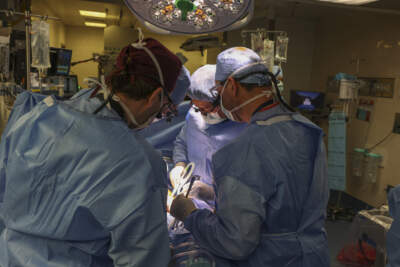
<p>The procedure begins with Kevin wailing intermittently while five adults hold him and a doctor administers a &#8220;dart,&#8221; a large injection, of ketamine to sedate him almost to the point of unconsciousness. It&#8217;s the only moment during the course of his surgery that comes across as harsh in any way. But, as the nurse anesthetist explains later: &#8220;Sometimes the quickest knife cuts the best.&#8221; It&#8217;s true, once the dart ordeal is over, things run fairly smoothly: Kevin is able to remain fully dressed, with his shoes on and with no IV as he&#8217;s wheeled into the OR.</p>
<p>Rowe explains a bit about the surgery: she&#8217;ll remove the natural lens of the eye, which in Kevin&#8217;s case had grown cloudy, with a loss of transparency &#8212; that&#8217;s the cataract. After removing the lens through an incision, she&#8217;ll replace it with a synthetic, transparent lens which will also correct his vision. (Also under anesthesia, Dr. Rowe called in ENT Dr. Anand Devaiah to clean out Kevin&#8217;s ears: it turns out they were packed with large rocks of Coca-Cola-colored wax.)</p>
<p><strong>Another Hospital &#8216;Would Shut Us Down&#8217;</strong></p>
<p>In the time it takes to operate on Kevin (who is covered by MassHealth and Medicare) Rowe could have done three routine cataract surgeries, she says, earning three times the money for her own practice and for the hospital. &#8220;I&#8217;m afraid to ask how much we lose on these cases but I suspect it&#8217;s several thousand per eye,&#8221; she said. &#8220;The chiefs are all supportive &#8212; it&#8217;s not like it&#8217;s guerrilla eye service. But if the finance people at any other hospital tried to analyze our losses, they would have already shut us down.&#8221;</p>
<p>With at least six medical professionals in the OR, including the anesthesiologist and nurse anesthetist, a resident and several nurses, the surgery begins. Rowe teaches the technique as she goes along, working away with a scalpel and ultrasound. There&#8217;s a slight delay when she finds Kevin’s iris loose and floppy, requiring her to stabilize it. &#8220;I&#8217;m having some challenges,&#8221; she says.</p>
<p>Eventually, she implants a tiny acrylic lens through a small incision. She stitches it up as tightly as possible and then pushes and prods the eye to be sure that the wound is secure; she wants to be certain that when Kevin rubs his eye, he won&#8217;t cause damage to the wound or dislodge the lens. She intentionally leaves the eye anesthesia-free. &#8220;If he&#8217;s going to knuckle his eye, he&#8217;s going to feel it,&#8221; she says. (He might get a pain pill later if he appears uncomfortable, but his eye will never be &#8220;asleep.&#8221;)</p>
<p><strong>Never Again</strong></p>
<p>Rowe wasn&#8217;t always this confident. Her &#8220;aha&#8221; moment came about 12 years ago, when she was treating a patient with Down syndrome whose sight was deteriorating fast. He could no longer recognize family members, or see to feed himself. He was scared, and would no doubt be tough to care for. Still, Rowe and her colleagues decided to take the risk and operate.</p>
<p>Rowe says that while in residency at the Massachusetts Eye and Ear Infirmary, a Harvard teaching hospital, she learned cataract surgery for this type of population in a specific way: &#8220;You put somebody under general anesthesia, anesthetize their eye while they&#8217;re asleep, do the surgery and then do everything you can and hope they don&#8217;t touch their eye for at least a week or more.&#8221;</p>
<p>But that approach didn&#8217;t work well with this particular patient: he woke up from surgery, hated the patch and immediately wanted to grab his eye.</p>
<p>&#8220;He was very agitated and wanted to touch his eye and we couldn&#8217;t let him,&#8221; Rowe said. &#8220;So what we had to do is tie his arms down, and admit him to the hospital where we actually restrained him for the better part of a week with physical restraints and with a lot of sedation. He was very frightened, very angry and he didn&#8217;t know what was going on. It was terrible for him and for the family and for me.</p>
<p>&#8220;I felt after that&#8230;there has to be a better way&#8230;It wasn&#8217;t clear we&#8217;d done the best possible thing for this man and I decided I couldn&#8217;t keep doing that &#8212; I couldn&#8217;t see doing that kind of surgery again.&#8221;</p>
<p>She began investigating different options. She revisited an older type of procedure, called scleral tunnel surgery, which involves a more extensive surgery but yields a much sturdier wound. It&#8217;s a technique &#8220;that has fallen out of favor,&#8221; she said. &#8220;It&#8217;s not the kind of surgery you see as often in 2012, 2013.&#8221;</p>
<p>&#8220;I won&#8217;t say it&#8217;s not scary to send someone home without a patch,&#8221; she says. &#8220;It flies against everything I&#8217;ve been taught and everyone else has been taught around here. It takes a certain ability to live with risk.&#8221;</p>
<p>Many doctors are unwilling to take on that kind of risk. &#8220;I can tell you that many of the people who come to me have been looking [for a willing doctor] for years,&#8221; Rowe said. &#8220;They&#8217;ve either been told they&#8217;re not a candidate for this surgery or they&#8217;ve been given options for surgery that are too invasive or scary&#8230;by the time they come to me, their function is so impaired.&#8221;</p>
<p>Jean Ramsey, associate professor for ophthalmology and pediatrics at Boston University School of Medicine and a program director at BMC&#8217;s Department of Ophthalmology, says, &#8220;Dr. Rowe&#8217;s commitment to this population has made it possible for many patients to receive surgical care who otherwise may not have been able to receive it.&#8221;</p>
<p>Rowe acknowledges that she couldn&#8217;t do this kind of work without a team of committed medical providers. &#8220;We do a lot of strategizing before the surgery,&#8221; Rowe says. Not only does this approach require doctors willing to work collaboratively and outside standard procedures, it also relies on nurses willing to take extra time and tenderness if a patient is kicking or screaming or unwilling to wear a wrist band, Rowe says. The team also depends on schedulers who can remain calm when patients repeatedly cancel and reschedule appointments.</p>
<p>One surgical tech nurse, Ellen Gallery, who works with Rowe, likens the complex dance of getting such challenging patients into the OR to a &#8220;seduction.&#8221;</p>
<p>&#8220;To get it all right the way she does and get the patient in here, it&#8217;s not an induction, it&#8217;s seduction,&#8221; Gallery said.</p>
<p>But, Rowe says, this type of team effort is not easy to sustain. &#8220;Under our current health care system, there is a financial penalty for this kind of collaboration. Each aspect of care gets paid significantly less than if we did everything separately. One change that I would love to see as we reform health care would be to financially incentivize teamwork and collaborative care over individual episodes of care.&#8221;</p>
<p><strong>&#8216;It&#8217;s A Miracle&#8217;</strong></p>
<p>After the surgery, Rowe holds Kevin&#8217;s hand and urges him awake.</p>
<p>When he opens his eyes, his sister and caregivers are ready, plying him with coffee and chocolate pudding. &#8220;Whatever you like today, Kevin, it&#8217;s your day,&#8221; Blanchette says.</p>
<p>Kevin&#8217;s caregivers notice the improvement almost immediately.</p>
<p>&#8220;This has changed his life,&#8221; Peter Scully says. &#8220;It&#8217;s amazing he made it through both surgeries. Here&#8217;s a guy who couldn&#8217;t see, and now he can see. It&#8217;s a miracle.&#8221;</p>
<p>Poitras and Scully decided that if Kevin did make it through the surgeries they&#8217;d reward him with a trip to the aquarium where he could enjoy his new vision: see the fluorescent fish and crazy-patterned eels, touch the sharks and rays and hang out with the seals.</p>
<p>On a raw morning earlier this year we meet at the New England Aquarium in Boston where Kevin smiles for pictures in front of the jellyfish and allows an aquarium worker to help him navigate the touch tank. &#8220;If his eyes weren&#8217;t fixed, he&#8217;d never be able to do this,&#8221; Poitras says.</p>
<p>The caregivers tick off all the post-surgical improvements in Kevin&#8217;s life: his anxiety, aggression and overall agitation are way down. He&#8217;s working again (bringing home $30-40 a week, far more than when he could barely see). He&#8217;s much more social, playing his music and greeting visitors when they come to the group home. &#8220;He&#8217;ll go into the day room and turn his music on &#8212; all around he feels more comfortable, he can tolerate crowds a lot more than he used to,&#8221; Poitras says.</p>
<p>Blanchette adds that after the surgery: &#8220;His whole demeanor completely changed; he&#8217;d calmed and gone back to his old self. He could see and he could see me, I was so grateful.&#8221;</p>
<p>Kevin&#8217;s coffee addiction goes back to childhood (Pam suspects coffee was used as a reward at the mental institution). So as another special treat, Kevin got his own coffee maker after the surgeries. Now, for the first time, he makes his own morning coffee. &#8220;That&#8217;s huge,&#8221; Poitras says. &#8220;He&#8217;s never been able to do it before without hurting himself.&#8221;</p>
<p>And this is just the beginning. &#8220;We&#8217;re slowly going to introduce him to more activities, horseback riding, swimming, we&#8217;re hoping he&#8217;ll lose some of that weight,&#8221; Poitras says. &#8220;He&#8217;s always had problems with medical treatment, but now we&#8217;re going to take him for a few more appointments.&#8221;</p>
<p>Scully&#8217;s planning to buy Kevin a treadmill now that he can see again and says he hopes Kevin&#8217;s success inspires others: &#8220;It may pave the way for other developmentally disabled individuals and their staff to approach Boston Medical. If they see we were able to do it they might think, &#8216;We can do it too.&#8217; &#8221;</p>
<p>At the fur seal tank, Kevin stares transfixed as Lou, a blind seal, flops around, while another seal called Isaac squirms away when the trainer tries to get a blood sample. &#8220;He&#8217;s just like you Kevin,&#8221; Scully says. As the seals dive and play, Kevin leans over the railing, and begins rocking back and forth &#8212; a characteristic trait of autism. Poitras, the nurse, snaps a photo. &#8220;It may not look like it, but that,&#8221; he says gesturing, &#8220;is Kevin happy.&#8221;</p>
<p><em>(Note: This special CommonHealth report was produced by Rachel Zimmerman, George Hicks and Jesse Costa. All photos, video and reporting for the story were gathered with consent from Kevin&#8217;s legal guardian.)</em></p>
]]></content:encoded>
                		
    <media:content url="http://commonhealth.wbur.org/files/2013/05/kevin06-620x415.jpg" type="image/jpeg" height="415" width="620" medium="image">
            <media:thumbnail url="http://commonhealth.wbur.org/files/2013/05/kevin06-140x140.jpg" height="140" width="140" />
            <media:description><![CDATA[Kevin Fitzgerald, after surgery, his vision restored (George Hicks/WBUR)]]></media:description>
    </media:content>
		<dcterms:modified>2013-05-03T20:57:54-04:00</dcterms:modified>
    	</item>
		<item>
		<title>Editorial: All Emergency Care Should Aspire To Be Like Boston</title>
		<link>http://commonhealth.wbur.org/2013/04/boston-emergency-docs-rock</link>
		<comments>http://commonhealth.wbur.org/2013/04/boston-emergency-docs-rock#comments</comments>
		<pubDate>Tue, 23 Apr 2013 12:43:11 +0000</pubDate>
		<dc:creator><![CDATA[]]></dc:creator>
				<category><![CDATA[Medicine/Science]]></category>
		<category><![CDATA[Money]]></category>
		<category><![CDATA[Personal Health]]></category>

		<guid isPermaLink="false">http://commonhealth.wbur.org/?p=29269</guid>
		<description><![CDATA[An editorial in The Lancet says the Boston medical community's  "rapid, exceedingly well-orchestrated, and inspiring response" following the Marathon bombings should be a model for emergency care around the world.]]></description>
                <content:encoded><![CDATA[<p>An <a href="http://www.thelancet.com/journals/lancet/article/PIIS0140-6736(13)60861-2/fulltext">editorial</a> in the medical journal <em>The Lancet</em> today sums up the communal gratitude much of Boston is now feeling toward the emergency doctors, nurses and other hospital staff who have been caring for victims of the Marathon bombing over the past week: they rock. </p>
<p>Not only will all of the patients who have been or continue to be treated in area hospitals survive, according to reports, but the institutions were amazingly prepared for the harrowing disaster. </p>
<p>After the two explosions at the Marathon finish line, which killed three people and injured more than 200, doctors and hospitals mobilized with &#8220;a rapid, exceedingly well-orchestrated, and inspiring response,&#8221; the Lancet notes:</p>
<blockquote><p>Immediately, medical and emergency personnel who were staffing the event swept in to treat the wounded and to secure the area, and the first wave of the injured were quickly transported to the network of hospitals nearby. In the context of such an emergency, the city of Boston is an unparalleled setting because of its great number of top-tier medical facilities and teaching hospitals. Ten hospitals, including Brigham and Women&#8217;s Hospital, Tufts Medical Center, and Massachusetts General Hospital, received and treated the injured. Importantly, they were at the ready. Upon being alerted of the explosions, local hospitals initiated a cascade of actions: emergency rooms were cleared, patients in less critical condition were diverted to increase capacity, and clinical teams were mobilised to aid in the triage of victims. All of the routine disaster rehearsals, coordinated training, and special awareness of the types of injuries they would be treating meant that clinical staff were poised to act.<span id="more-29269"></span> These well-practised plans undoubtedly served to minimise injuries and loss of life.</p></blockquote>
<p>The editorial concludes that, indeed, Boston&#8217;s response should serve as a model for the global medical community. &#8220;Boston has set an excellent example that response efficacy and strength is built on planning and preparation. Emergency systems everywhere should aspire to be Boston strong.&#8221;</p>
<p>Meanwhile, <em>The Boston Globe</em> <a href="http://www.bostonglobe.com/metro/massachusetts/2013/04/22/just-bombing-victims-still-critically-ill-but-count-injured-rises/7mUGAu5tJgKsxc634NCAJJ/story.html?p1=Well_BG_Links">reports</a> that only two patients hurt in last Monday&#8217;s bombings remain in critical condition, but that the tally of injuries has jumped to over 280, with some people not seeking treatment immediately after the blasts. Many of those with less serious injuries are dealing with hearing loss and ear injuries, as WBUR&#8217;s Sacha Pfeiffer <a href="http://www.wbur.org/2013/04/18/marathon-ear-injuries">reported</a> last week. </p>
<p>And <em>The New York Times</em> today reports that attention is now turning to the cost of caring for the wounded, and how charitable funds for bombing victims will be doled out:</p>
<blockquote><p>Kenneth R. Feinberg, the lawyer who has overseen compensation funds for victims of the Sept. 11 terrorist attacks, the shootings at Virginia Tech and other disasters, arrived in Boston on Monday to start the difficult work of deciding who will be eligible for payouts from a new compensation fund and how much each person wounded in the bombings and family of the dead deserves.</p>
<p>The One Fund Boston, which Mayor Thomas M. Menino of Boston and Gov. Deval Patrick of Massachusetts created a day after the bombings, has already raised more than $10 million for victims and their families. At the same time, friends and relatives have set up dozens of smaller funds for individual victims.</p>
<p>For at least 13 victims who lost limbs, including William White of Bolton, Mass., expenses may also include renovations to their homes that make it easier for them to get around.</p></blockquote>
]]></content:encoded>
                		
    <media:content url="http://commonhealth.wbur.org/files/2013/04/marathonbombs.jpg" type="image/jpeg" height="309" width="600" medium="image">
            <media:thumbnail url="http://commonhealth.wbur.org/files/2013/04/marathonbombs-140x140.jpg" height="140" width="140" />
            <media:description><![CDATA[Police clear the area at the finish line of the 2013 Boston Marathon as medical workers help injured following the explosions. (Charles Krupa/AP)]]></media:description>
    </media:content>
		<dcterms:modified>2013-04-23T18:54:41-04:00</dcterms:modified>
    	</item>
	</channel>
</rss>